What does it do?
It breaks down food using a broad chewing surface.

A molar is a large back tooth with a broad chewing surface and several cusps. It breaks down food at the back of the mouth. Both primary and permanent dentitions contain molars. The first permanent molars erupt behind the primary molars rather than replacing a baby tooth in that position.
For training & practice ↓
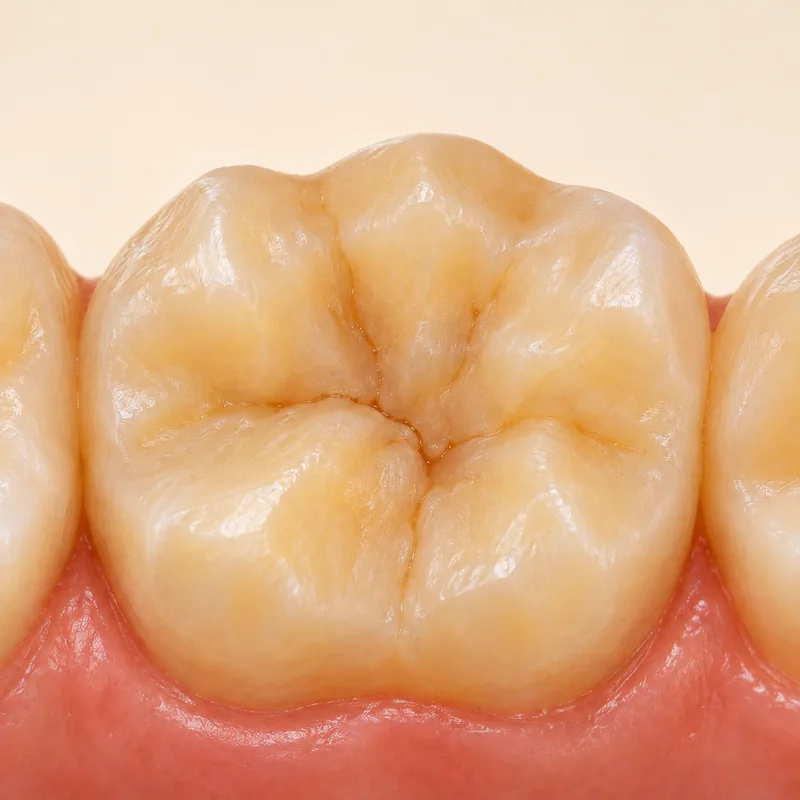
Several cusps and the grooves between them form the chewing surface. This differs from the cutting edge of an incisor.
Premolars are smaller back teeth; molars are larger ones. Permanent molars sit behind the premolars. Wisdom teeth are third molars.
A first permanent molar may already be present while baby teeth remain in front. Primary molars are later replaced by premolars.
It breaks down food using a broad chewing surface.
Recognising and cleaning permanent molars even while baby teeth are still present.
By examination; a dark mark alone is not a diagnosis.
Three steps. No audio.
Each scene can also be selected manually.

Silent educational film with German on-screen text and simplified teaching images. Not a patient case or a promised treatment outcome. The full English explanation is available below.
Several cusps and the grooves between them form the chewing surface. This differs from the cutting edge of an incisor.
Premolars are smaller back teeth; molars are larger ones. Permanent molars sit behind the premolars. Wisdom teeth are third molars.
A first permanent molar may already be present while baby teeth remain in front. Primary molars are later replaced by premolars.
Both are back teeth. A premolar is a smaller back tooth and a molar a larger one. Primary molars are not simply smaller permanent molars.
Usually several. Upper molars commonly have three roots and lower molars commonly have two. Variations occur, and the number of root canals is not automatically the same as the number of roots.
A first permanent molar usually erupts behind the primary tooth row without a baby tooth falling out there. This is why it can be mistaken for a baby tooth.
Not necessarily. An examination is needed to distinguish staining from a carious change.
An editorially suggested question for a conversation with Dr. med. dent. Niusha Barahmand Pour:
Which back teeth are already permanent, and what matters when cleaning them?
A newly erupted back tooth or an unusual chewing surface is worth checking.
Have a back tooth checkedAppointment selection at DoctolibBoth are back teeth. A premolar is a smaller back tooth and a molar a larger one. Primary molars are not simply smaller permanent molars.
Editorial research: . General information, not an individual diagnosis or treatment recommendation. Teaching illustrations are simplified and do not depict a patient case.