What do the abbreviations mean?
MIM refers to the malformation and MIH to hypomineralisation.

In this rarely reported developmental condition, first permanent molars may have unusually short or slender roots and an altered pulp chamber. The crown may appear unremarkable from the outside. Some upper incisors show a constriction near the neck.
For training & practice ↓
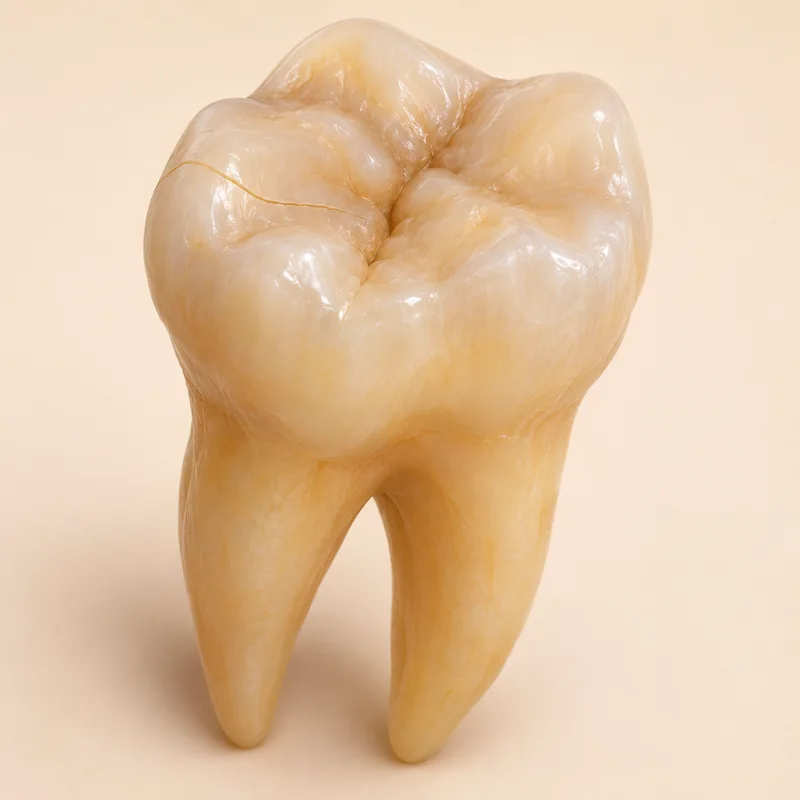
Molar crown enamel may look largely unremarkable. The main question concerns the roots and internal anatomy of the affected tooth.
Examined molars showed features including short roots and a mineralised plate in the cervical region narrowing the pulp space.
The patient’s radiograph helps assess root support. When there is pain or infection the team considers whether cleaning, restoration and retention are feasible.
MIM refers to the malformation and MIH to hypomineralisation.
The pattern can vary.
Small case series cannot prove individual causation.
Three steps. No audio.
Each scene can also be selected manually.

Silent film with English on-screen text and simplified teaching images.
A developmental pattern affecting several teeth requires a different assessment from a single root altered after injury.
No. Molar–incisor hypomineralisation primarily affects enamel mineralisation. MIM particularly affects roots and the pulp chamber.
No. In a six-child case series all had affected first permanent molars. Only two also had constrictions affecting upper incisors.
Small case series report possible associations with early illness. They cannot establish causation in an individual child.
A question to bring along
Which teeth are affected and what follow-up makes sense for my child?
Symptoms or unusual radiographic findings warrant an individual care plan.
Choose an appointmentAppointment selection at DoctolibThe published findings include small case series and microscopic examination of extracted molars.
Editorial research: . General information, not an individual diagnosis or treatment recommendation. Teaching illustrations are simplified and do not depict a patient case.
If you turn this on, this website stores which guides you open, separately from advertising preferences. The markers expire after a fixed 30-day period from activation. The list is not sent to us by this feature. You can turn it off here and delete the markers.
Other people using the same browser profile can also see the markers. German and English versions share one marker. Expired entries are removed the next time you open a page with this feature; deleting browser data may remove them earlier. “Viewed” means opened, not read or completed.