Is every swelling under the tongue a tumour?
There are many possible causes. Swelling that repeatedly increases at mealtimes can indicate a blocked salivary duct.

It starts in the soft tissues under the mobile tongue, usually in the surface lining. Lifting the tongue can reveal a persistent sore or firm lump. Some early changes cause little discomfort. Floor of the mouth
For training & practice ↓
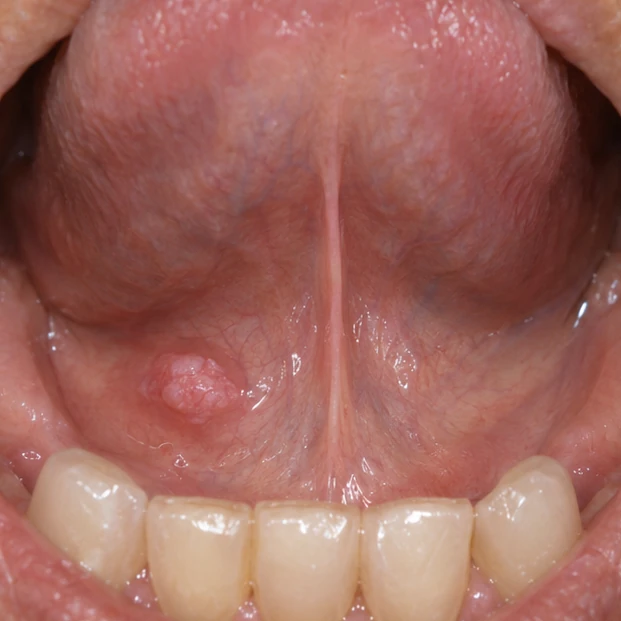
A persistent change under the tongue deserves examination. The pale bump shown here illustrates a nonspecific finding.
Swelling that repeatedly increases at mealtimes can reflect impaired saliva drainage. Clinical examination helps determine the cause.
A suspicious area may require a biopsy. Assessment of disease extent and neck lymph nodes follows if cancer is confirmed.
There are many possible causes. Swelling that repeatedly increases at mealtimes can indicate a blocked salivary duct.
Explain when you first noticed the change, whether it is growing or bleeding and whether it restricts tongue movement.
An examination includes the floor of the mouth, the tongue and the neck. A biopsy can establish whether the lesion is cancerous. If cancer is confirmed, a specialist team assesses the extent of the tumour and the neck lymph nodes. Oral cavity cancer
Three steps. No audio.
Each scene can also be selected manually.

Silent film with English on-screen text and simplified teaching images.
Swelling that repeatedly increases at mealtimes can reflect impaired saliva drainage. Clinical examination helps determine the cause.
There are many possible causes. Swelling that repeatedly increases at mealtimes can indicate a blocked salivary duct. A persistent firm lump or a sore that does not heal deserves examination. A photograph cannot reliably distinguish these causes. Salivary stone
Explain when you first noticed the change, whether it is growing or bleeding and whether it restricts tongue movement. Mention any new neck lump. Arrange prompt dental, ENT or oral and maxillofacial assessment for these findings. German guidance recommends prompt specialist assessment for an unexplained change in the oral lining that has lasted more than two weeks.
An examination includes the floor of the mouth, the tongue and the neck. A biopsy can establish whether the lesion is cancerous. If cancer is confirmed, a specialist team assesses the extent of the tumour and the neck lymph nodes. Oral cavity cancer
A question to ask
Does the change arise from the floor of my mouth, and who should assess it further?
Seek prompt dental, ENT or maxillofacial assessment for a new firm area, a sore or restricted tongue movement.
Choose an appointmentAppointment selection at DoctolibAn abnormality on the underside of a raised tongue can lie immediately above a lesion of the floor of the mouth. Document the precise site, mobility, consistency and relationship to the salivary ducts.
Editorial research: . General information, not an individual diagnosis or treatment recommendation. Teaching illustrations are simplified and do not depict a patient case.
If you turn this on, this website stores which guides you open, separately from advertising preferences. The markers expire after a fixed 30-day period from activation. The list is not sent to us by this feature. You can turn it off here and delete the markers.
Other people using the same browser profile can also see the markers. German and English versions share one marker. Expired entries are removed the next time you open a page with this feature; deleting browser data may remove them earlier. “Viewed” means opened, not read or completed.