Risk-free after healing?
No.

An oral piercing is jewellery passed through tissue in or around the mouth, such as the tongue or lip. Unlike a bonded tooth gem, it creates a piercing channel. Possible consequences include infection, swelling, damage to teeth and gums, and loose jewellery parts. A healed piercing is not automatically free of risk.
For training & practice ↓
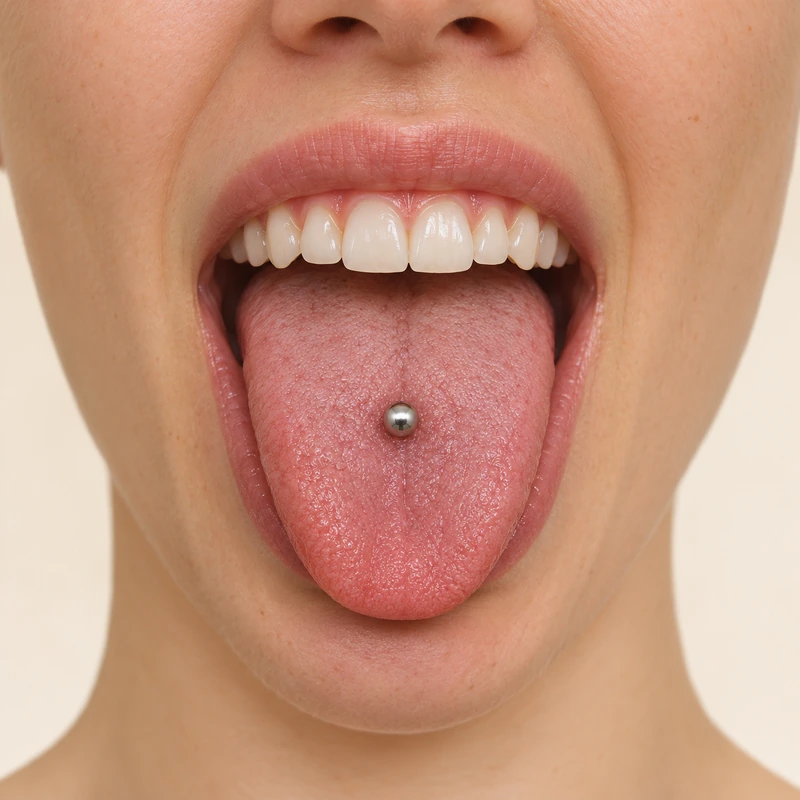
Jewellery can strike or rub teeth and gums. Repeated contact may contribute to chipping and gum recession.
New swelling, pain, bleeding or unusual discharge needs assessment. A long-standing piercing can still cause problems.
Tell the team about the piercing’s type and location before examination or treatment. Discuss whether it needs removal for a particular procedure.
No.
Yes.
Yes, before examination.
Three steps. No audio.
Each scene can also be selected manually.

Silent educational film with German on-screen text and simplified teaching images. Not a patient case or a promised treatment outcome. The full English explanation is available as text.
A piercing passes through tissue. A tooth gem is bonded to a tooth surface. Their risks and the checks needed are therefore different.
No material makes an oral piercing inherently risk-free. Contact, shape, movement and hygiene remain relevant; individual assessment is useful.
Yes. Biting on or playing with jewellery can damage tooth tissue. Avoid tapping it against teeth or chewing on it.
An exposed root surface or altered gum level at a contact point needs checking. Not every change has the same cause.
Seek timely medical or dental advice on what to do. Do not cut, twist or forcibly remove embedded jewellery or jewellery in a severely swollen area.
Call 112 immediately in Germany for breathing difficulty or rapidly increasing swelling in the mouth or neck. Heavy bleeding that does not stop also needs immediate medical help.
You can bring this question to your appointment:
Are there already signs of contact damage on my teeth or gums from the jewellery?
Have new contact damage, pain or swelling assessed promptly. Use the appropriate emergency route for acute warning signs.
Discuss dental careAppointment selection at DoctolibA piercing passes through tissue. A tooth gem is bonded to a tooth surface. Their risks and the checks needed are therefore different.
Editorial research: . General information, not an individual diagnosis or treatment recommendation. Teaching illustrations are simplified and do not depict a patient case.
If you turn this on, this website stores which guides you open, separately from advertising preferences. The markers expire after a fixed 30-day period from activation. The list is not sent to us by this feature. You can turn it off here and delete the markers.
Other people using the same browser profile can also see the markers. German and English versions share one marker. Expired entries are removed the next time you open a page with this feature; deleting browser data may remove them earlier. “Viewed” means opened, not read or completed.