Is it contagious?
No. It is an autoimmune disease.

Oral mucous membrane pemphigoid is an autoimmune blistering disease that can affect the mouth lining and gums. Immune reactions separate tissue layers; broken blisters often leave sore areas. It is not contagious. Similar-looking changes have other causes, so specific diagnostic testing is needed.
For training & practice ↓
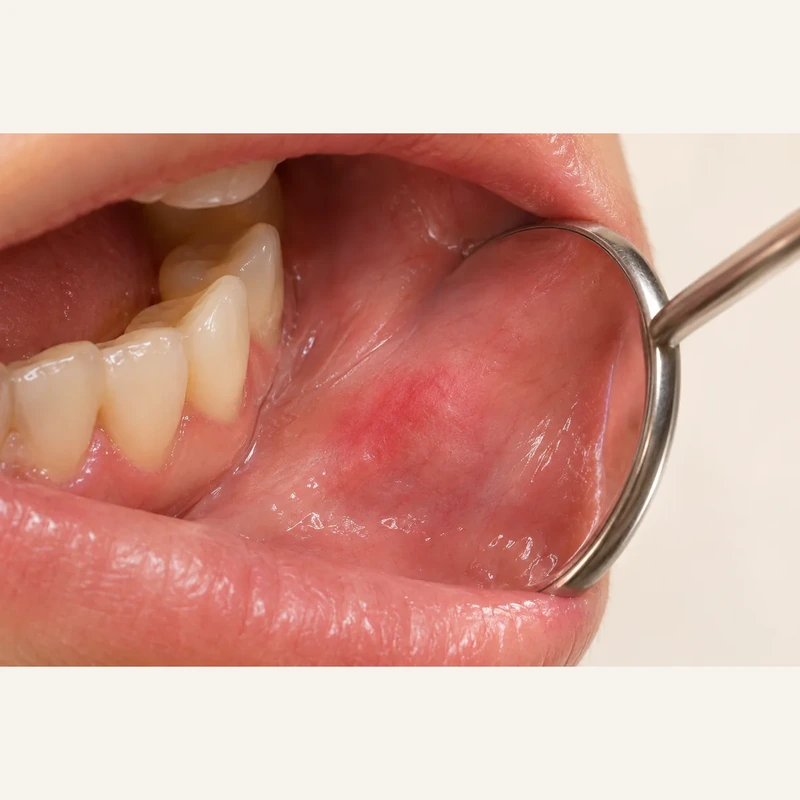
Blisters can break quickly. Redness, burning or painful gums alone do not prove the disease, and neither does a photograph.
An appropriately taken biopsy with histological and immunological testing helps establish the diagnosis. Further tests are selected according to the findings.
The eyes or throat may also be involved. Treatment depends on the extent and severity; coordinated care across specialties may be important.
No. It is an autoimmune disease.
Specific tissue tests and assessment of other relevant mucosal sites.
New eye symptoms require urgent medical or ophthalmic assessment.
Three steps. No audio.
Each scene can also be selected manually.

Silent educational film with German on-screen text and simplified teaching images. Not a patient case or a promised treatment outcome. The full English explanation is available as text.
Both are autoimmune blistering diseases, but they target different structures and cause different tissue changes. The names are not interchangeable; specialised tissue tests distinguish them.
No. It is an immune-mediated disease. Bacterial plaque may add to discomfort but does not alone explain the condition.
Mucous membrane pemphigoid can cause eye scarring. An ophthalmologist can check for early involvement even when oral symptoms are the main concern.
An ordinary rinse does not replace diagnosis and targeted therapy. The responsible team selects local or systemic medicines to suit the findings.
You can bring this question to your appointment:
Which tissue tests are needed, and should my eyes or other mucosal sites be assessed?
An individual examination can clarify the findings and suitable next steps.
Arrange an assessmentAppointment selection at DoctolibBoth are autoimmune blistering diseases, but they target different structures and cause different tissue changes. The names are not interchangeable; specialised tissue tests distinguish them.
Editorial research: . General information, not an individual diagnosis or treatment recommendation. Teaching illustrations are simplified and do not depict a patient case.
If you turn this on, this website stores which guides you open, separately from advertising preferences. The markers expire after a fixed 30-day period from activation. The list is not sent to us by this feature. You can turn it off here and delete the markers.
Other people using the same browser profile can also see the markers. German and English versions share one marker. Expired entries are removed the next time you open a page with this feature; deleting browser data may remove them earlier. “Viewed” means opened, not read or completed.