Which movement brings the lips together?
Lip closure.

The orbicularis oris lies in the lips around the mouth opening. Its fibres help close, press and purse the lips. These actions contribute to eating, drinking, speech and facial expression.
For training & practice ↓
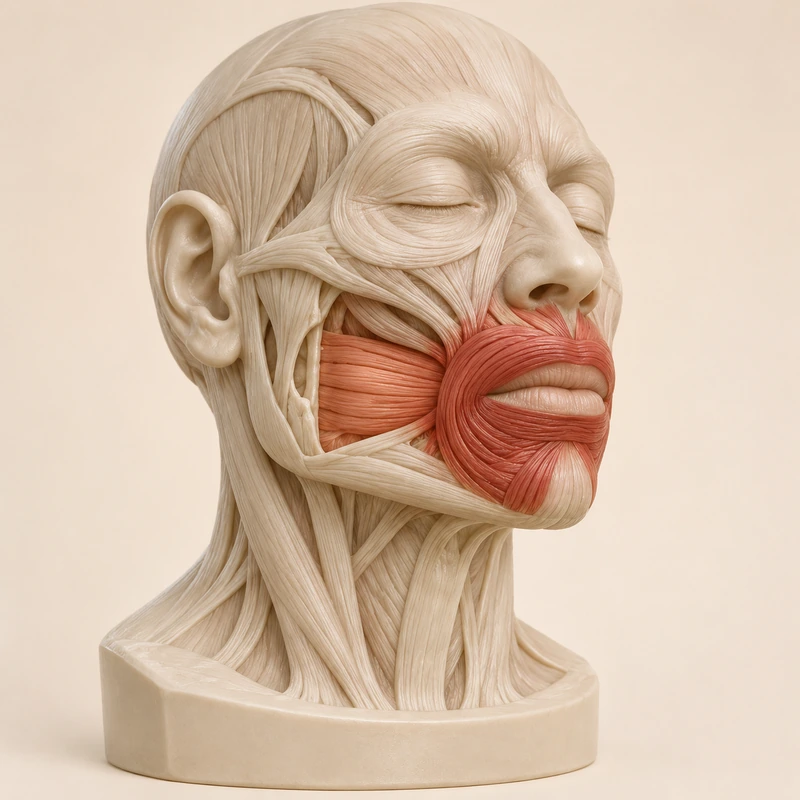
The lips meet during closure. This helps retain fluid in the mouth even when the teeth are apart.
Pursing shapes the lips forwards. This changes the mouth opening more precisely than moving the jaw alone.
During eating the cheek holds food beside the teeth while the lips can seal the mouth at the front. The two regions perform different tasks.
Lip closure.
The lips are pursed forwards.
The buccinator in the cheek wall.
Three steps. No audio.
Each scene can also be selected manually.

Silent educational film with German on-screen text and simplified teaching images. Not a patient case or a promised treatment outcome. The full English explanation is available as text.
The frenulum is a visible mucosal fold between the lip and gum. Orbicularis oris is muscle tissue within the lips.
The lips meet during closure. This helps retain fluid in the mouth even when the teeth are apart.
Pursing shapes the lips forwards. This changes the mouth opening more precisely than moving the jaw alone.
During eating the cheek holds food beside the teeth while the lips can seal the mouth at the front. The two regions perform different tasks.
Yes. Lip movement and mandibular movement can occur independently. Closing the lips does not require tight tooth contact.
The frenulum is a visible mucosal fold between the lip and gum. Orbicularis oris is muscle tissue within the lips.
A question you could ask
Does my concern involve lip closure, the position of my teeth or the labial frenulum?
At your appointment, describe whether lip closure is difficult at rest, when drinking or during speech.
Discuss at a dental appointmentAppointment selection at DoctolibThe frenulum is a visible mucosal fold between the lip and gum. Orbicularis oris is muscle tissue within the lips.
Editorial research: . General information, not an individual diagnosis or treatment recommendation. Teaching illustrations are simplified and do not depict a patient case.
If you turn this on, this website stores which guides you open, separately from advertising preferences. The markers expire after a fixed 30-day period from activation. The list is not sent to us by this feature. You can turn it off here and delete the markers.
Other people using the same browser profile can also see the markers. German and English versions share one marker. Expired entries are removed the next time you open a page with this feature; deleting browser data may remove them earlier. “Viewed” means opened, not read or completed.