Where is the buccinator?
In the cheek wall beneath its lining.

The buccinator forms part of the muscular wall of the cheek. It presses the cheek against the teeth and helps keep food between the biting surfaces during chewing. It also controls cheek tension during blowing and sucking.
For training & practice ↓
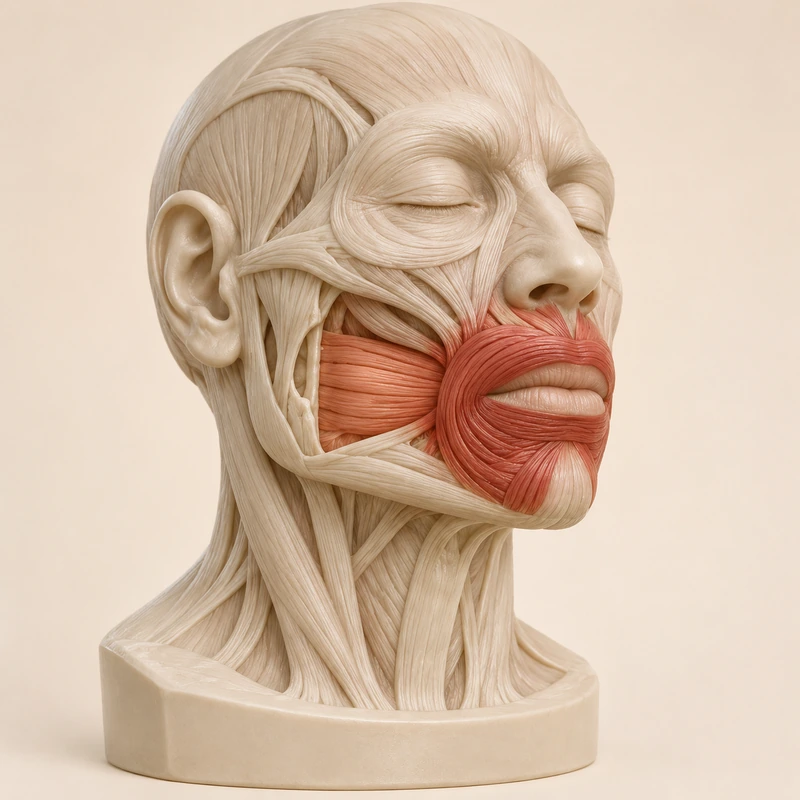
The muscle lies between the outer skin and inner cheek lining. The mucosal surface faces the oral vestibule.
Contraction brings the cheek towards the back teeth. It helps guide food from the space beside the teeth back towards the chewing surfaces.
The space between the cheek and teeth is part of the oral vestibule. Cheek movement and lip closure work together to keep food in the mouth.
In the cheek wall beneath its lining.
It guides food back towards the chewing surfaces.
The oral vestibule.
Three steps. No audio.
Each scene can also be selected manually.

Silent educational film with German on-screen text and simplified teaching images. Not a patient case or a promised treatment outcome. The full English explanation is available as text.
The buccinator primarily moves the cheek. The masseter pulls on the mandible and produces much of the force when biting.
The muscle lies between the outer skin and inner cheek lining. The mucosal surface faces the oral vestibule.
Contraction brings the cheek towards the back teeth. It helps guide food from the space beside the teeth back towards the chewing surfaces.
The space between the cheek and teeth is part of the oral vestibule. Cheek movement and lip closure work together to keep food in the mouth.
Whistling, blowing and sucking require cheek tension. The buccinator works with the lip muscles during these activities.
The buccinator primarily moves the cheek. The masseter pulls on the mandible and produces much of the force when biting.
A question you could ask
Could cheek movement, the lining of my cheek or tooth contact be involved in my symptoms?
If cheek symptoms recur, point out where you notice them when eating.
Discuss at a dental appointmentAppointment selection at DoctolibThe buccinator primarily moves the cheek. The masseter pulls on the mandible and produces much of the force when biting.
Editorial research: . General information, not an individual diagnosis or treatment recommendation. Teaching illustrations are simplified and do not depict a patient case.
If you turn this on, this website stores which guides you open, separately from advertising preferences. The markers expire after a fixed 30-day period from activation. The list is not sent to us by this feature. You can turn it off here and delete the markers.
Other people using the same browser profile can also see the markers. German and English versions share one marker. Expired entries are removed the next time you open a page with this feature; deleting browser data may remove them earlier. “Viewed” means opened, not read or completed.