Which cranial nerve?
The fifth.

The trigeminal nerve is the fifth cranial nerve. Its three main divisions carry sensation from much of the face, teeth and mouth. The mandibular division also contains motor fibres supplying chewing muscles. The name describes a normal nerve; trigeminal neuralgia is a particular pain disorder, not another name for the nerve.
For training & practice ↓
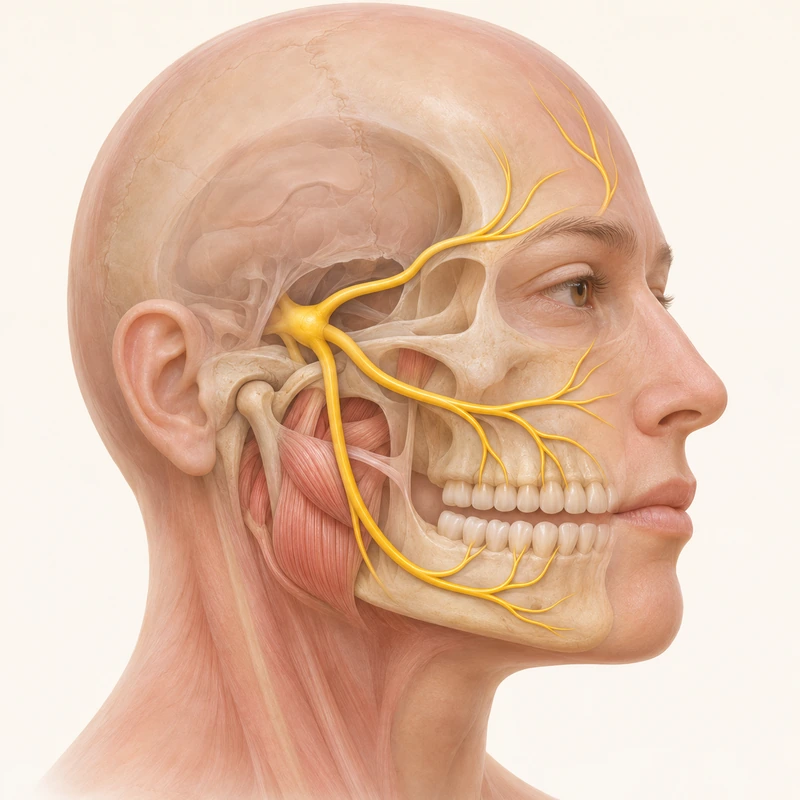
V1, V2 and V3 are the ophthalmic, maxillary and mandibular divisions. Their territories explain the pathways of many dental and facial sensations.
All three divisions carry sensory signals. Motor fibres supplying chewing muscles travel in the mandibular division, V3.
Facial pain may have dental or other causes. If dental findings do not explain it, medical or neurological assessment may be needed.
The fifth.
Three on each side.
No.
Three steps. No audio.
Each scene can also be selected manually.

Silent educational film with German on-screen text and simplified teaching images. Not a patient case or a promised treatment outcome. The full English explanation is available as text.
The nerve is a normal anatomical structure. Neuralgia is a pain disorder and cannot be diagnosed from pain location alone.
It has three major divisions: ophthalmic, maxillary and mandibular. There is a trigeminal nerve on each side of the head.
Its branches transmit sensations from the teeth. This does not by itself identify what caused the pain.
No. Many conditions can cause facial pain. Neuralgia requires an appropriate medical diagnosis; a normal dental image alone does not establish it.
Yes. Motor fibres in its mandibular division control important chewing muscles. The other two divisions are primarily sensory.
A dentist can investigate dental and oral causes. Depending on the findings, a primary care doctor, neurologist or another appropriate specialist may be involved. Not every cause is treated dentally.
You can bring this question to your appointment:
Do dental or oral findings explain my pain, or should another specialist assess it?
A dental examination can clarify how this relates to your findings and treatment planning.
Discuss your dental findingsAppointment selection at DoctolibThe nerve is a normal anatomical structure. Neuralgia is a pain disorder and cannot be diagnosed from pain location alone.
Editorial research: . General information, not an individual diagnosis or treatment recommendation. Teaching illustrations are simplified and do not depict a patient case.
If you turn this on, this website stores which guides you open, separately from advertising preferences. The markers expire after a fixed 30-day period from activation. The list is not sent to us by this feature. You can turn it off here and delete the markers.
Other people using the same browser profile can also see the markers. German and English versions share one marker. Expired entries are removed the next time you open a page with this feature; deleting browser data may remove them earlier. “Viewed” means opened, not read or completed.