What is more useful than one test?
The combined assessment of contact, contour and symptoms.

An open proximal contact means a filling fails to meet its neighbouring tooth at the contact area. Food can be pushed between the teeth during chewing and irritate the gum. Assessment includes contact tightness, restoration contour, the bite and surrounding tissue.
For training & practice ↓
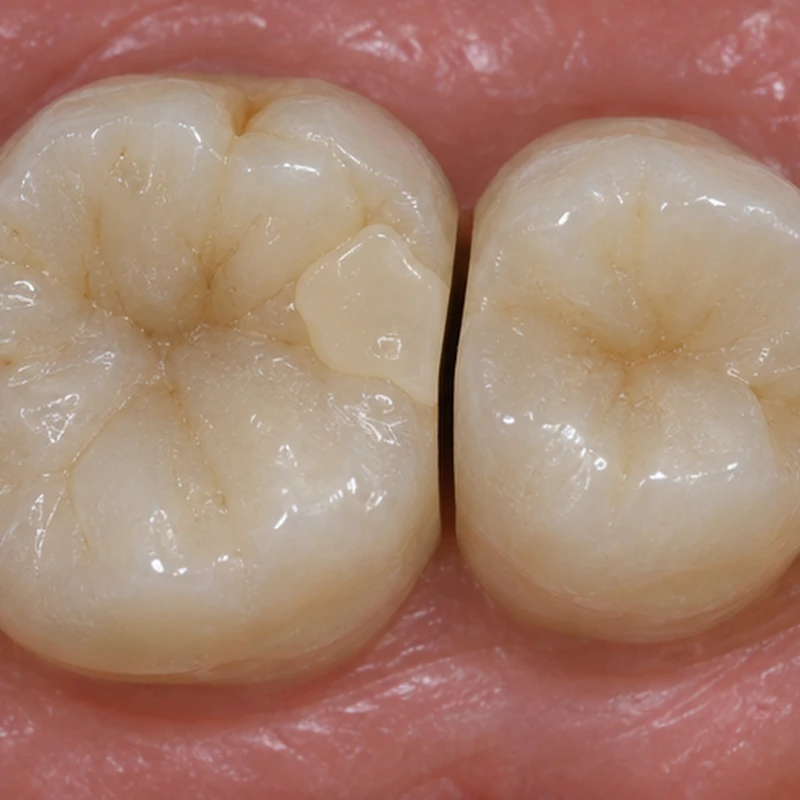
From above, the model shows a narrow continuous gap between neighbouring posterior teeth. Normally their side surfaces meet over a limited area.
Mention if food fibres repeatedly lodge at the same spot. Floss provides one clue, while the contour and tissues also need examination.
A matrix helps shape a restoration towards the next tooth. After correction the team checks contour, contact and access for cleaning.
The combined assessment of contact, contour and symptoms.
On the facing proximal surfaces.
Extent, access and condition of the remaining filling.
Three steps. No audio.
Each scene can also be selected manually.

Silent film with English on-screen text and simplified teaching images.
An overhang projects beyond the intended contour. An open contact lacks contact with the neighbouring tooth.
It is a clue. A contact may already have been open beforehand. Its position, previous findings and actual symptoms matter.
The space below the contact is part of normal anatomy and is often filled by the papilla. An open contact concerns the area where the crowns should touch.
This depends on whether the contact can be rebuilt while retaining the sound restoration. More extensive defects may need replacement.
A question to bring along
Can the contact area be corrected locally?
If food repeatedly packs in or the gum hurts after a filling, have that particular space assessed.
Choose an appointmentAppointment selection at DoctolibA missing crown contact and an open gingival embrasure describe different anatomical findings.
Editorial research: . General information, not an individual diagnosis or treatment recommendation. Teaching illustrations are simplified and do not depict a patient case.
If you turn this on, this website stores which guides you open, separately from advertising preferences. The markers expire after a fixed 30-day period from activation. The list is not sent to us by this feature. You can turn it off here and delete the markers.
Other people using the same browser profile can also see the markers. German and English versions share one marker. Expired entries are removed the next time you open a page with this feature; deleting browser data may remove them earlier. “Viewed” means opened, not read or completed.