What is its shape?
A rounded, convex underside.

An ovate pontic is a bridge tooth with a rounded, convex underside that extends into a suitably shaped depression in the mucosa. This can create a more natural-looking emergence from the gums. It remains part of a bridge and has no tooth root of its own at that site. Available tissue, careful contouring and daily cleaning access determine whether the design is appropriate.
For training & practice ↓
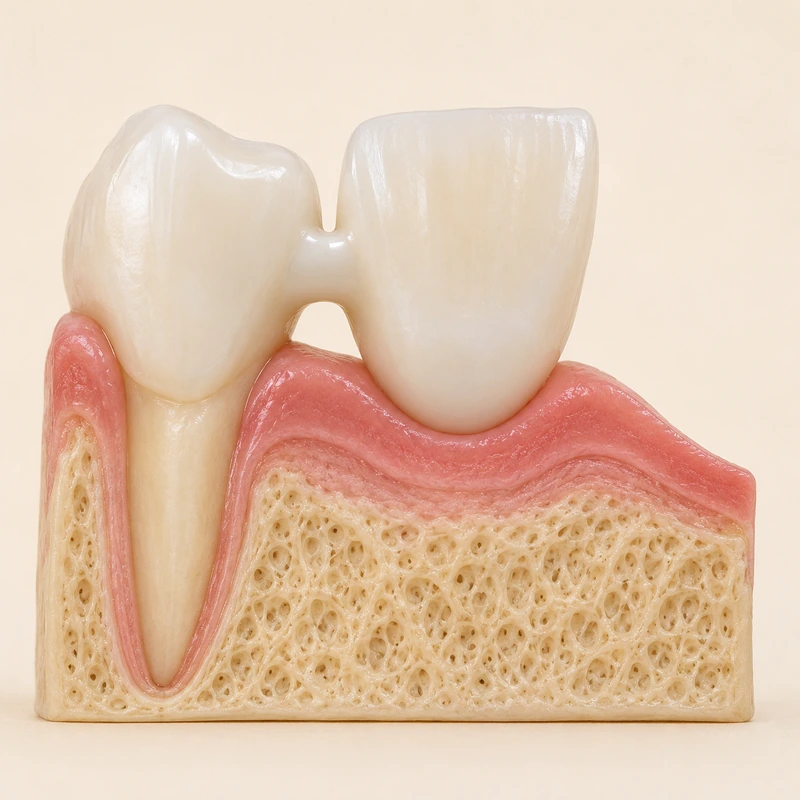
The rounded underside sits in a shaped soft-tissue depression. It should not be mistaken for a root anchored in bone. The bridge construction supports the replacement tooth.
A provisional restoration may help develop the final tissue contour. Additional treatment may be needed depending on the starting situation. Shaping and healing are reviewed; no appearance is guaranteed.
Close-fitting bridge teeth still need daily cleaning. The team can demonstrate suitable aids. Bleeding, pressure sores or pain need review, rather than increasingly forceful cleaning.
A rounded, convex underside.
A natural-looking transition to the mucosa.
Suitable tissue, cleaning access and follow-up.
Three steps. No audio.
Each scene can also be selected manually.

Silent educational film with German on-screen text and simplified teaching images. Not a patient case or a promised treatment outcome. The full English explanation is available as text.
The appearance of emerging from the gum is a design effect. It does not mean that the pontic is anchored by a natural periodontal ligament.
No. The term describes the mucosal shape of a bridge tooth. A bridge may have different types of support; the pontic itself is not an implant root.
No. Ridge contour, soft tissue, visibility and the ability to clean influence selection. Another design may be more appropriate in a particular situation.
No. Smooth, cleanable contours and careful hygiene matter, but cannot guarantee healthy mucosa indefinitely. Tissue response and pressure need review.
You can bring this question to your appointment:
Is this pontic shape suitable for my tissue, and how can I clean underneath it safely?
An individual assessment can clarify the findings and whether referral is needed.
Arrange an assessmentAppointment selection at DoctolibThe appearance of emerging from the gum is a design effect. It does not mean that the pontic is anchored by a natural periodontal ligament.
Editorial research: . General information, not an individual diagnosis or treatment recommendation. Teaching illustrations are simplified and do not depict a patient case.
If you turn this on, this website stores which guides you open, separately from advertising preferences. The markers expire after a fixed 30-day period from activation. The list is not sent to us by this feature. You can turn it off here and delete the markers.
Other people using the same browser profile can also see the markers. German and English versions share one marker. Expired entries are removed the next time you open a page with this feature; deleting browser data may remove them earlier. “Viewed” means opened, not read or completed.