Who is this for?
Patients discussing findings and dental trainees learning tooth types.

Premolars are the smaller posterior teeth between the canines and the molars. A complete permanent dentition usually has eight, two in each quarter of the mouth. Their chewing surfaces help break down food. Root number is not identical in every premolar.
For training & practice ↓
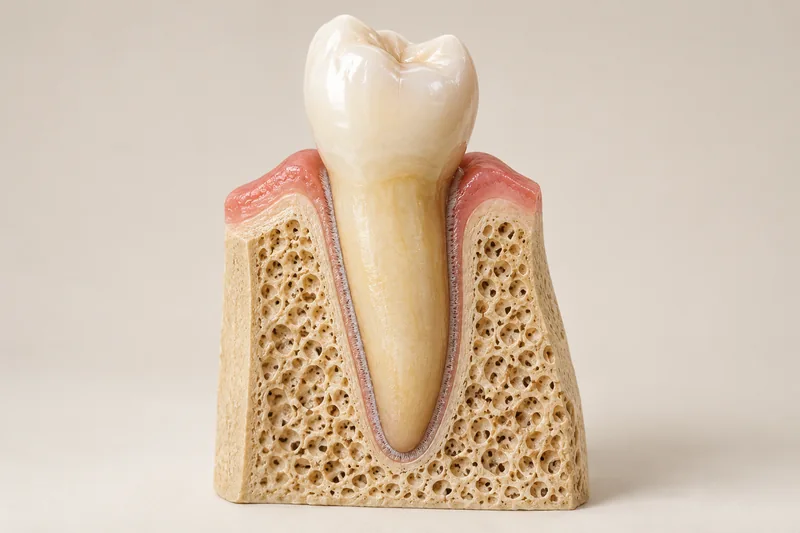
Counting from the midline, premolars are the fourth and fifth teeth. They belong to the permanent dentition. There are no premolars in the primary dentition; primary molars occupy their future positions.
The crown has a chewing surface with cusps. Lower premolars usually have one root. Upper premolars, especially the first ones, may have one or more roots, and individual variations occur.
A root can contain one or more canals. Seeing one root therefore does not automatically mean there is only one root canal. Treatment relies on the individual anatomy assessed clinically.
Patients discussing findings and dental trainees learning tooth types.
As the fourth or fifth tooth from the midline in a permanent tooth row.
An explicitly labelled lower premolar with one root; variations are explained separately.
Three steps. No audio.
Each scene can also be selected manually.

Silent educational film with German on-screen text and simplified teaching images. Not a patient case or a promised treatment outcome. The full English explanation is available below.
Counting from the midline, premolars are the fourth and fifth teeth. They belong to the permanent dentition. There are no premolars in the primary dentition; primary molars occupy their future positions.
The crown has a chewing surface with cusps. Lower premolars usually have one root. Upper premolars, especially the first ones, may have one or more roots, and individual variations occur.
A root can contain one or more canals. Seeing one root therefore does not automatically mean there is only one root canal. Treatment relies on the individual anatomy assessed clinically.
Premolars are the smaller posterior teeth in front of the molars. Molars are the larger teeth further back. Size, chewing surfaces and root anatomy differ, with individual variation.
No. Premolars belong to the permanent tooth row. During tooth replacement they succeed the primary molars, while permanent molars erupt further back.
No. Many are single-rooted, particularly lower premolars. Upper first premolars show more varied root forms. Showing every premolar with two roots would be misleading.
Root canal treatment, extraction and other planning need to account for anatomy and possible variations. An educational graphic does not replace an individual examination.
An editorially suggested question for a discussion with Dr med dent Niusha Barahmand Pour:
Which tooth does my finding refer to, and are there anatomical features that matter for the planned treatment?
Unsure which tooth your findings refer to? An appointment can clarify its position using the dental chart.
Discuss a dental findingAppointment selection at DoctolibPremolars are the smaller posterior teeth in front of the molars. Molars are the larger teeth further back. Size, chewing surfaces and root anatomy differ, with individual variation.
Editorial research: . General information, not an individual diagnosis or treatment recommendation. Teaching illustrations are simplified and do not depict a patient case.