How can enlarged adenoids affect my child's hearing?
The tubes that ventilate the middle ears open near the adenoids.

The adenoids are a single area of immune tissue behind the nose, high in the throat. When enlarged, they can restrict airflow through the nose. A child may breathe through the mouth more often or snore at night. The tonsils that you see on either side when the mouth is open are separate structures. Palatine tonsils
For training & practice ↓
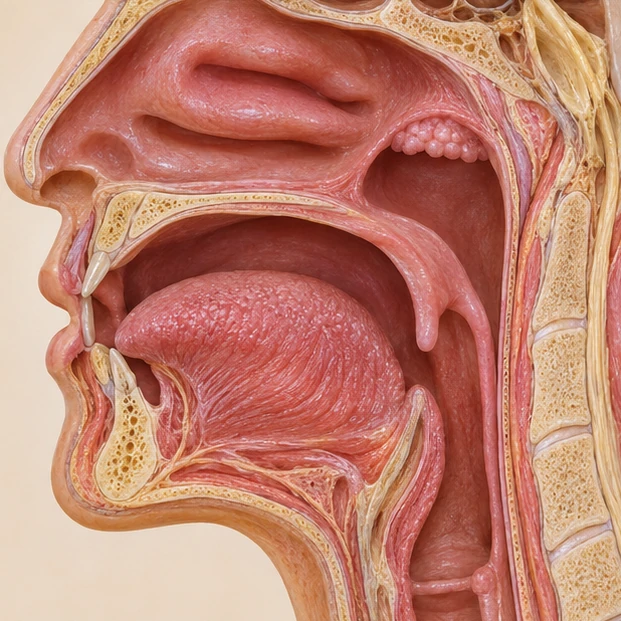
The adenoids sit at the roof of the nasopharynx, above the soft palate.
When a child opens their mouth the palatal arches can be seen. The adenoids are hidden farther back.
Enlarged tissue in the nasopharynx can obstruct nasal breathing. Pauses in breathing during sleep and hearing problems also matter.
The tubes that ventilate the middle ears open near the adenoids.
They are hidden behind the soft palate during an ordinary mouth examination. Depending on the child's age and ability to cooperate, an ENT clinician may use a thin scope to examine the area. Hearing and middle-ear function can also be tested.
The decision depends on symptoms and their impact.
Three steps. No audio.
Each scene can also be selected manually.

Silent film with English on-screen text and simplified teaching images.
When a child opens their mouth the palatal arches can be seen. The adenoids are hidden farther back.
The tubes that ventilate the middle ears open near the adenoids. If ventilation is impaired for a long time, fluid may collect behind the eardrum and voices may sound muffled. Persistent hearing difficulties should be assessed by a paediatrician or an ENT specialist.
They are hidden behind the soft palate during an ordinary mouth examination. Depending on the child's age and ability to cooperate, an ENT clinician may use a thin scope to examine the area. Hearing and middle-ear function can also be tested.
The decision depends on symptoms and their impact. Observation can be appropriate for mild symptoms. Repeated pauses in breathing during sleep, marked nasal obstruction or persistent hearing problems warrant medical assessment. Surgery is an option in selected cases.
A question to ask
Should my child's hearing, nasal breathing or sleep be assessed by an ENT specialist?
Seek paediatric or ENT assessment for repeated breathing pauses, persistent mouth breathing or hearing problems.
Find an ENT or paediatrics practice in GermanyFind a medical practice with 116117The pharyngeal tonsil is an unpaired structure in the pharyngeal lymphoid ring. Enlargement in childhood can affect middle-ear ventilation. In German, families may call enlarged adenoids “Polypen”. Nasal polyps are a different condition.
Editorial research: . General information, not an individual diagnosis or treatment recommendation. Teaching illustrations are simplified and do not depict a patient case.
If you turn this on, this website stores which guides you open, separately from advertising preferences. The markers expire after a fixed 30-day period from activation. The list is not sent to us by this feature. You can turn it off here and delete the markers.
Other people using the same browser profile can also see the markers. German and English versions share one marker. Expired entries are removed the next time you open a page with this feature; deleting browser data may remove them earlier. “Viewed” means opened, not read or completed.