Why the name ghost tooth?
Because of the faint radiographic outline.

Regional odontodysplasia is a rare developmental disorder affecting several dental hard tissues in a limited jaw segment. Adjacent teeth may have thin, poorly mineralised enamel and thin dentine. Their outlines can look faint on X-rays around comparatively wide pulp spaces.
For training & practice ↓
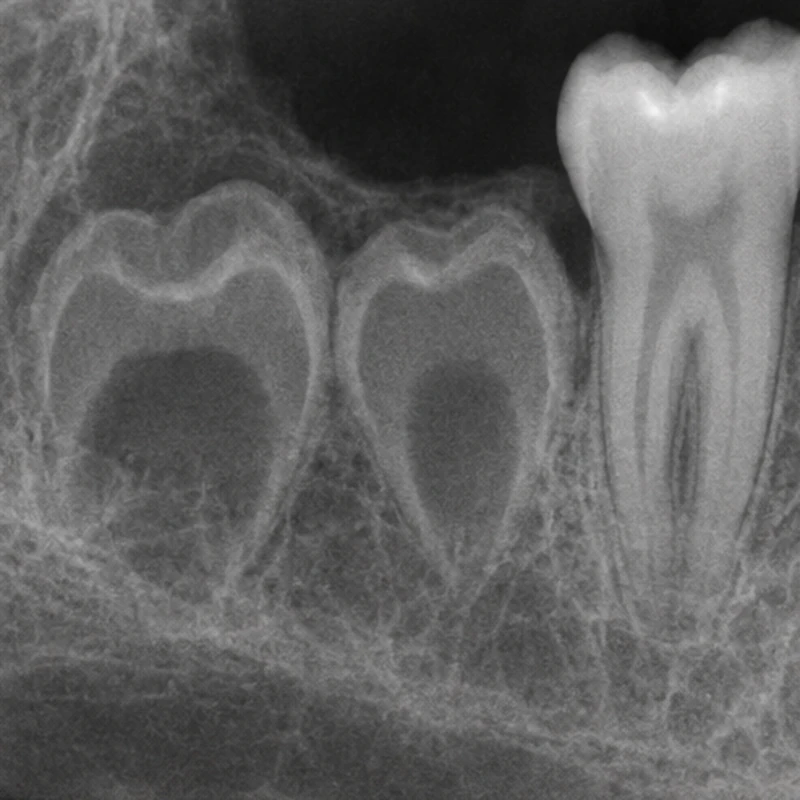
The simulated radiograph shows faint outlines around two adjacent teeth. The neighbouring tooth has a more prominent hard-tissue outline.
The model shows a wide internal space relative to its hard-tissue covering. The proportions in a real tooth can vary.
In a child, eruption, signs of infection, chewing function and further jaw growth all matter. Interim plans may change with development.
Because of the faint radiographic outline.
Several teeth in one area.
Growth and eruption over time.
Three steps. No audio.
Each scene can also be selected manually.

Silent film with English on-screen text and simplified teaching images.
In agenesis the tooth germ is absent. An odontodysplastic tooth can be present but poorly mineralised and difficult to see.
They may be present but look faint because of thin hard tissues. Eruption may be delayed or fail in some cases.
Typically a group of neighbouring teeth in one region is affected. Primary and permanent teeth can be involved. The extent is established by examination.
There is no universal requirement for removal. Symptoms, infection, development and restorability inform preservation, observation or replacement decisions.
A question to bring along
How can development and any symptoms in this part of the jaw be monitored?
Delayed eruption, recurrent swelling or pain warrant dental assessment.
Choose an appointmentAppointment selection at DoctolibMuch of the evidence for this rare condition comes from case series. Treatment is individual.
Editorial research: . General information, not an individual diagnosis or treatment recommendation. Teaching illustrations are simplified and do not depict a patient case.
If you turn this on, this website stores which guides you open, separately from advertising preferences. The markers expire after a fixed 30-day period from activation. The list is not sent to us by this feature. You can turn it off here and delete the markers.
Other people using the same browser profile can also see the markers. German and English versions share one marker. Expired entries are removed the next time you open a page with this feature; deleting browser data may remove them earlier. “Viewed” means opened, not read or completed.