Its aim?
To widen a suitable narrow jaw ridge.

Ridge splitting is a surgical method for widening a narrow toothless jaw ridge. A suitable bone segment is divided and expanded in a controlled way to create space for the planned implant position. It mainly addresses insufficient width. Remaining bone height, bone structure and nearby anatomy determine whether the technique is suitable.
For training & practice ↓
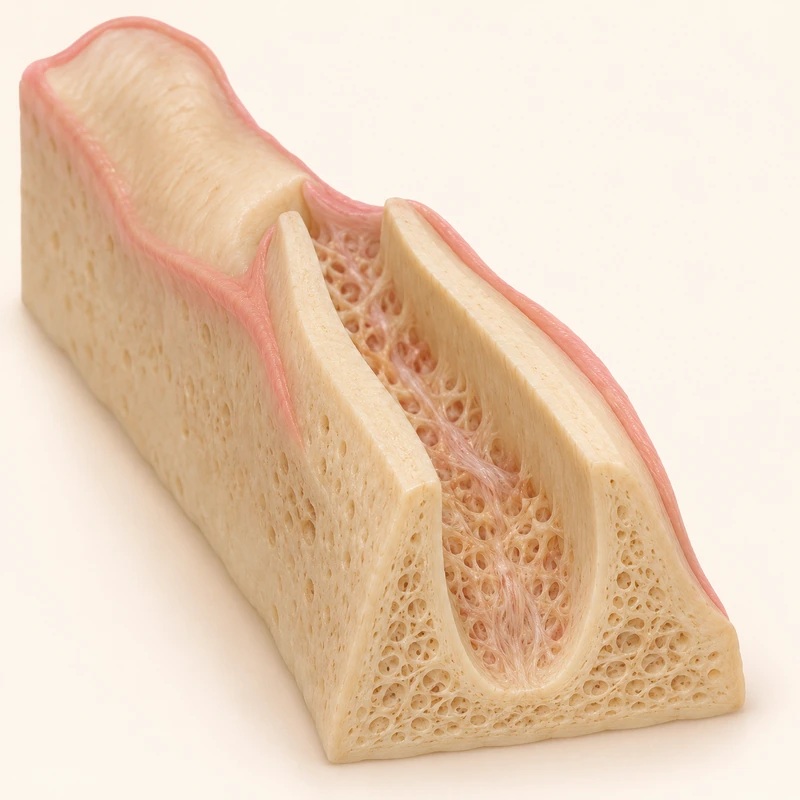
A ridge may lack width, height or volume in several directions. Ridge splitting targets width. The planned implant and replacement tooth positions guide the assessment.
The outer bone plates need an appropriate internal structure between them. Dense or unfavourably shaped bone cannot be expanded without limit; a cortical plate may fracture.
Implants may be placed at the same operation or later, depending on the findings. Additional augmentation may be needed. Risks, healing and other treatment options require discussion beforehand.
To widen a suitable narrow jaw ridge.
No; timing and stability are assessed individually.
An appropriately experienced surgical team.
Three steps. No audio.
Each scene can also be selected manually.

Silent educational film with German on-screen text and simplified teaching images. Not a patient case or a promised treatment outcome. The full English explanation is available as text.
Splitting primarily widens a narrow ridge during surgery. Distraction moves separated segments apart gradually over time so bone can form between them.
It is one particular method of ridge augmentation. Onlay grafting adds material; splitting expands existing bone. Techniques may be combined.
No. Often denser mandibular bone can make expansion harder. Height, width, shape and nearby sensitive structures need individual assessment.
They include cortical plate fracture, swelling, healing problems and, depending on the site, altered sensation. The planned procedure may therefore need modification.
You can bring this question to your appointment:
Is width the main problem in my case, and which alternative would suit unfavourable bone anatomy?
An individual assessment can clarify the findings and whether referral is needed.
Arrange an assessmentAppointment selection at DoctolibSplitting primarily widens a narrow ridge during surgery. Distraction moves separated segments apart gradually over time so bone can form between them.
Editorial research: . General information, not an individual diagnosis or treatment recommendation. Teaching illustrations are simplified and do not depict a patient case.
If you turn this on, this website stores which guides you open, separately from advertising preferences. The markers expire after a fixed 30-day period from activation. The list is not sent to us by this feature. You can turn it off here and delete the markers.
Other people using the same browser profile can also see the markers. German and English versions share one marker. Expired entries are removed the next time you open a page with this feature; deleting browser data may remove them earlier. “Viewed” means opened, not read or completed.