How does it form?
Enamel develops outside the part that will become the crown.

An enamel pearl is a rounded island of enamel in an unusual location on a tooth root. It forms as the tooth develops. Pearls often sit between the roots of a molar and may go unnoticed.
For training & practice ↓
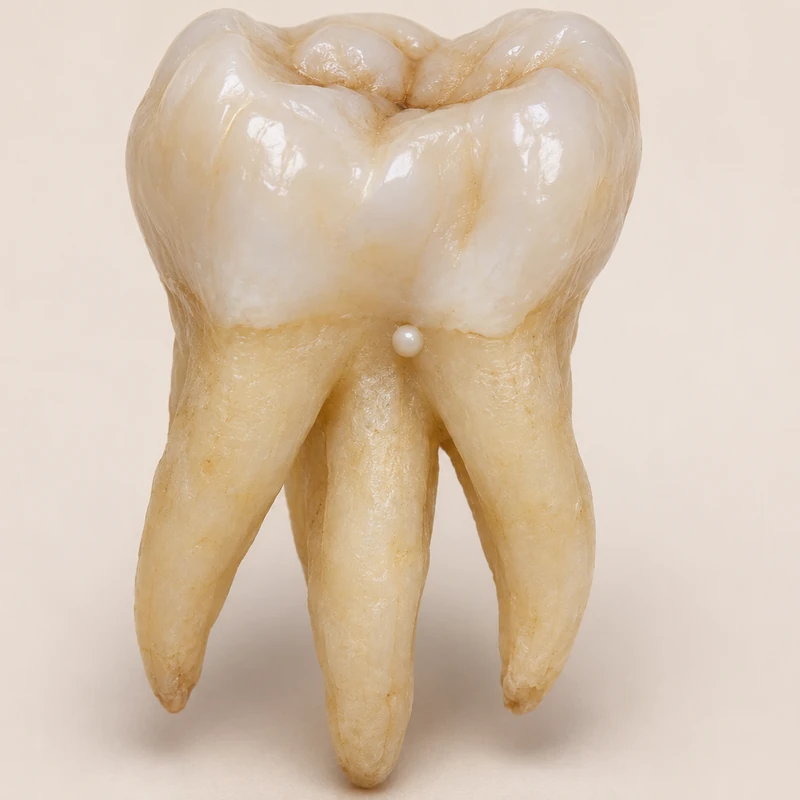
The bead has an outer layer of enamel. The surrounding root surface has a different texture.
The space where the roots divide can be hard to clean. A pearl can further alter the shape of this small recess.
The dentist examines the gum and checks access for cleaning. Where a pearl sits helps determine its significance.
Enamel develops outside the part that will become the crown.
A common site is the root division of an upper molar.
How easily the area can be reached and the health of the tissues supporting the tooth.
Three steps. No audio.
Each scene can also be selected manually.

Silent film with English on-screen text and simplified teaching images.
Calculus is a mineralised deposit. A pearl develops as part of the tooth and remains after routine cleaning.
The pearl forms during tooth development. Plaque can collect later around an awkward contour.
A pearl near the root division is often below the gum. Depending on its size and the angle of the X-ray, it may appear as a small bright structure.
An incidental finding alone does not determine this. Inflammation, access for cleaning and the likely benefit for that tooth guide the decision.
When a raised area is found
Does the pearl lie in a pocket, and how can I keep the area around it clean?
Meet Dr. Niusha Barahmand Pour ↗An enamel pearl forms a localised raised bead. An enamel projection extends from the crown surface towards the furcation.
Editorial research: . General information, not an individual diagnosis or treatment recommendation. Teaching illustrations are simplified and do not depict a patient case.
If you turn this on, this website stores which guides you open, separately from advertising preferences. The markers expire after a fixed 30-day period from activation. The list is not sent to us by this feature. You can turn it off here and delete the markers.
Other people using the same browser profile can also see the markers. German and English versions share one marker. Expired entries are removed the next time you open a page with this feature; deleting browser data may remove them earlier. “Viewed” means opened, not read or completed.