Part of the body?
Yes, it is the natural maxillary sinus lining.

In implant dentistry, the Schneiderian membrane refers to the natural lining of the maxillary sinus above the bone of the posterior upper jaw. During a sinus lift, this thin lining is carefully elevated to create space beneath it for bone augmentation. It is not an implanted material and should be distinguished from an additional barrier membrane.
For training & practice ↓
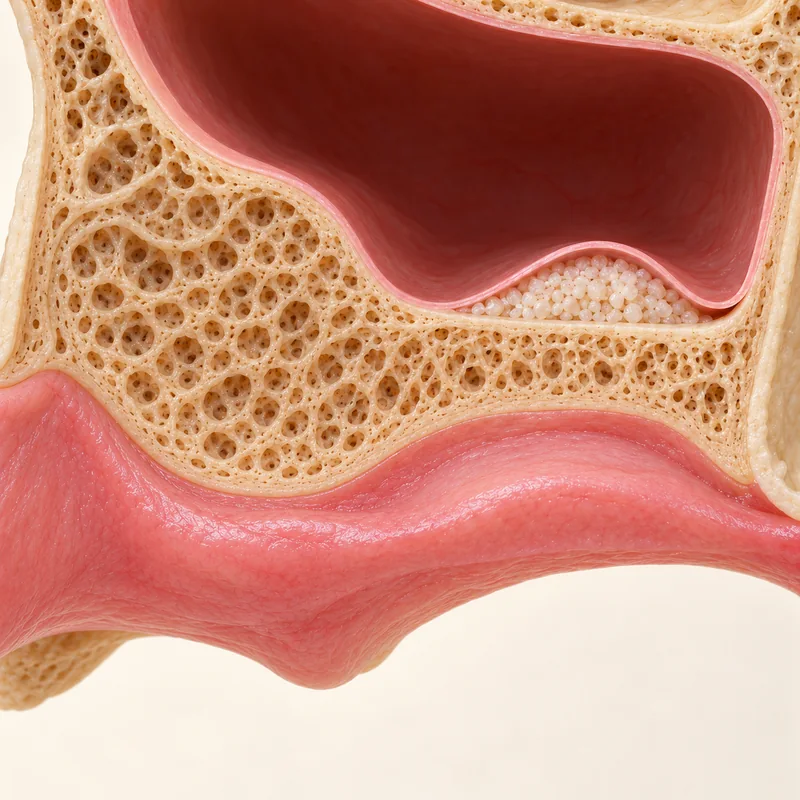
The maxillary sinus is an air-filled space above the upper back teeth. Its lining rests against the bony wall. In sinus-lift discussions this is called the Schneiderian membrane.
During a sinus lift, the lining is raised from the bony floor. Graft material is then placed beneath it. This illustrates the principle, not whether a particular person is suitable for surgery.
The thin lining can tear during surgery. Depending on the findings, a defect may be covered or the graft may need to be delayed. The surgical team makes this decision.
Yes, it is the natural maxillary sinus lining.
To create space for bone augmentation beneath it.
The surgical plan must be reassessed.
Three steps. No audio.
Each scene can also be selected manually.

Silent educational film with German on-screen text and simplified teaching images. Not a patient case or a promised treatment outcome. The full English explanation is available as text.
The natural maxillary sinus lining borders the cavity. A surgical barrier membrane is an additional material; these are different structures.
No. The Schneiderian membrane is part of the body. An additional barrier membrane is a separate material that may be used, for example, to manage a defect.
No. Smaller defects may be managed depending on their location and the circumstances. If a tear cannot be managed safely, stopping and replanning later may be appropriate. Success cannot be guaranteed.
Contact the treating surgical team if pain or swelling increases markedly, you develop fever, feel unwell or bleeding does not stop. Follow your individual postoperative instructions.
You can bring this question to your appointment:
What are my sinus and remaining bone like, and how would a membrane defect affect the plan?
An individual assessment can clarify the findings and whether referral is needed.
Arrange an assessmentAppointment selection at DoctolibThe natural maxillary sinus lining borders the cavity. A surgical barrier membrane is an additional material; these are different structures.
Editorial research: . General information, not an individual diagnosis or treatment recommendation. Teaching illustrations are simplified and do not depict a patient case.
If you turn this on, this website stores which guides you open, separately from advertising preferences. The markers expire after a fixed 30-day period from activation. The list is not sent to us by this feature. You can turn it off here and delete the markers.
Other people using the same browser profile can also see the markers. German and English versions share one marker. Expired entries are removed the next time you open a page with this feature; deleting browser data may remove them earlier. “Viewed” means opened, not read or completed.