What lies below?
Access to the retaining screw.

The screw access is the opening of a channel through a screw-retained implant crown. It allows the dental team to reach the retaining screw. The opening is sealed with a suitable material once the crown is in place.
For training & practice ↓
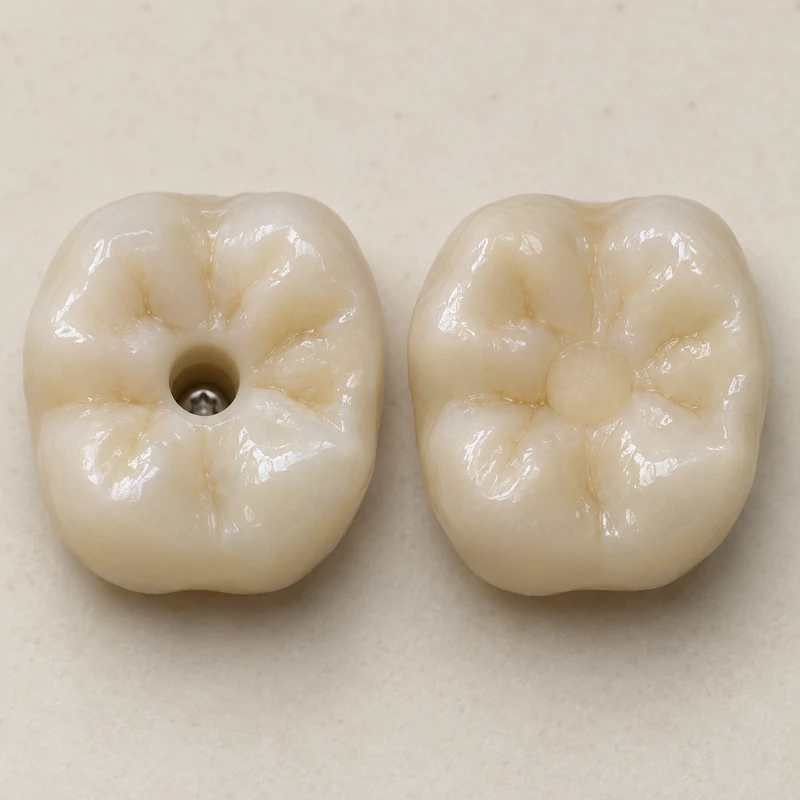
The two crowns show the difference between an open channel and a flush tooth-coloured seal.
The retaining screw is a separate component. The surface seal closes the channel to the mouth.
A missing seal and a loose screw are separate findings. Both should be assessed if the crown moves.
The two crowns show the difference between an open channel and a flush tooth-coloured seal.
The retaining screw is a separate component. The surface seal closes the channel to the mouth.
A missing seal and a loose screw are separate findings. Both should be assessed if the crown moves.
Access to the retaining screw.
The dental team.
Have the fit of the restoration checked promptly.
Three steps. No audio.
Each scene can also be selected manually.

Silent film with English on-screen text and simplified teaching images.
The appearance of the surface seal alone does not show whether the underlying screw is secure.
The ceramic itself cannot develop tooth decay. A spot on an implant crown may be the outline of the sealing material. A new depression or change deserves examination.
Tooth-coloured composite is one option. A clinical study compared composite seals with small ceramic inlays in posterior crowns. The construction depends on the restoration.
Arrange a check. If the crown moves, avoid putting pressure on it until it is assessed. Do not try to tighten a screw yourself or glue anything into the channel.
A question to bring along
Where is the screw access in my implant crown?
If the seal is missing or the crown moves, arrange a prompt assessment.
Choose an appointmentAppointment selection at DoctolibThe access may emerge on different surfaces depending on the tooth and channel direction.
Editorial research: . General information, not an individual diagnosis or treatment recommendation. Teaching illustrations are simplified and do not depict a patient case.
If you turn this on, this website stores which guides you open, separately from advertising preferences. The markers expire after a fixed 30-day period from activation. The list is not sent to us by this feature. You can turn it off here and delete the markers.
Other people using the same browser profile can also see the markers. German and English versions share one marker. Expired entries are removed the next time you open a page with this feature; deleting browser data may remove them earlier. “Viewed” means opened, not read or completed.