Where does it form?
On the inner surface of existing dentine.

Secondary dentine is dentine laid down slowly inside a tooth after its main development. This can gradually reduce the space available for the pulp. It is part of the natural development of the dentine–pulp complex, rather than a filling or an automatic sign of disease.
For training & practice ↓
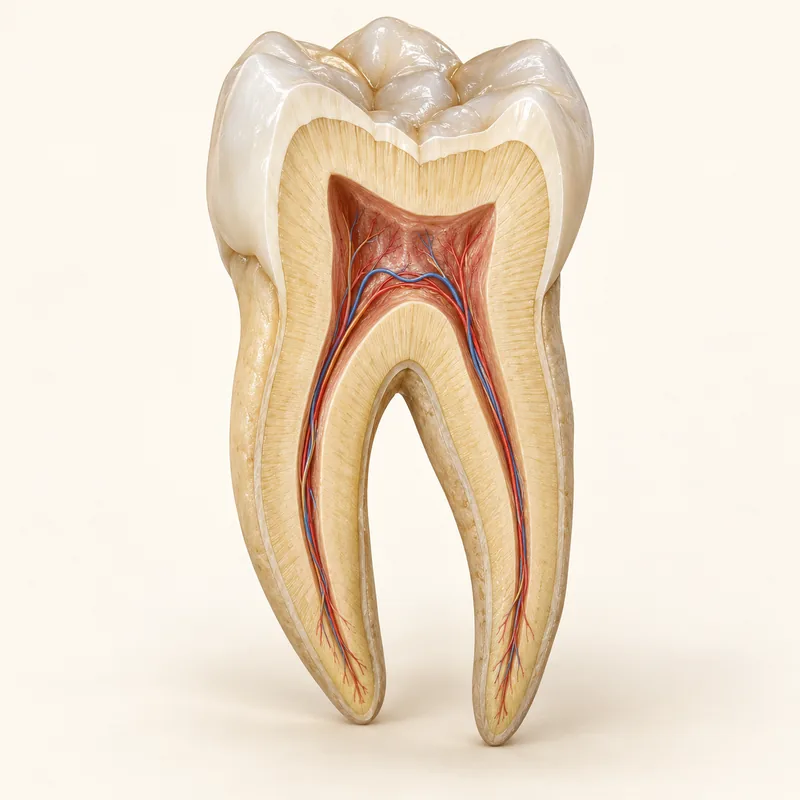
Dentine-forming cells at the pulp boundary can continue depositing hard tissue. This does not restore the tooth’s original external shape.
The additional internal layer can reduce the pulp chamber and canal space. A narrower space alone does not mean the pulp has died.
Narrow internal spaces can make later root canal treatment more demanding. Whether treatment is needed depends on symptoms and diagnosis, not dentine formation alone.
On the inner surface of existing dentine.
The space available for pulp can decrease.
No. Treatment requires a separate clinical indication.
Three steps. No audio.
Each scene can also be selected manually.

Silent educational film with German on-screen text and simplified teaching images. Not a patient case or a promised treatment outcome. The full English explanation is available as text.
Secondary dentine is a continuing internal deposit. Tertiary dentine forms in response to a stimulus. A pulp stone is a discrete calcification within the pulp space. These terms are not interchangeable.
No. Additional local dentine related to a stimulus is classified as tertiary dentine. Secondary dentine describes slower deposition after the main developmental stage.
No. Deposition takes place internally. It does not turn an external defect back into intact enamel.
No. Anatomical narrowing alone is not an indication. It is considered during planning if treatment becomes necessary.
You can bring this question to your appointment:
Is this narrowing of the pulp space an expected finding, and does it affect any necessary treatment?
An individual examination can clarify the findings and suitable next steps.
Arrange an assessmentAppointment selection at DoctolibSecondary dentine is a continuing internal deposit. Tertiary dentine forms in response to a stimulus. A pulp stone is a discrete calcification within the pulp space. These terms are not interchangeable.
Editorial research: . General information, not an individual diagnosis or treatment recommendation. Teaching illustrations are simplified and do not depict a patient case.
If you turn this on, this website stores which guides you open, separately from advertising preferences. The markers expire after a fixed 30-day period from activation. The list is not sent to us by this feature. You can turn it off here and delete the markers.
Other people using the same browser profile can also see the markers. German and English versions share one marker. Expired entries are removed the next time you open a page with this feature; deleting browser data may remove them earlier. “Viewed” means opened, not read or completed.