What is it?
A local calcified structure in dental pulp.

A pulp stone is a calcified structure within the dental pulp, the tissue containing nerves and blood vessels. It may be found incidentally. When root-canal treatment is needed, larger calcifications can make access to the canals more difficult.
For training & practice ↓
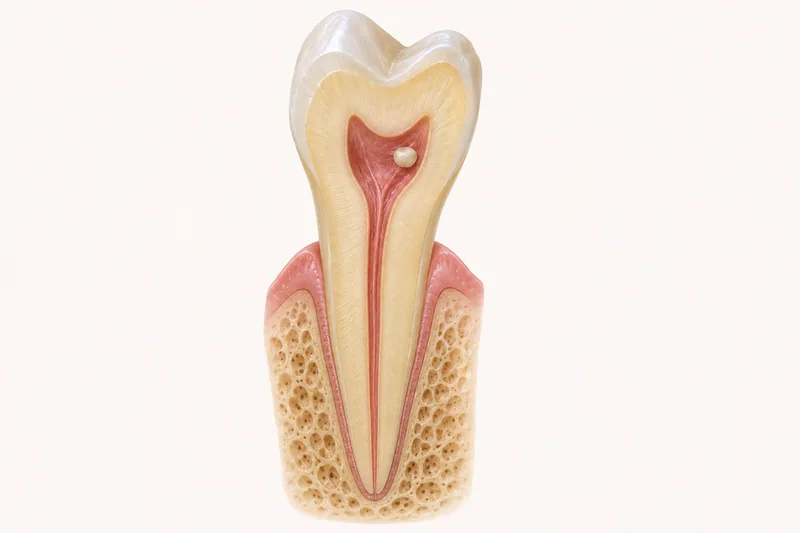
The pulp occupies the pulp chamber and root canals. A pulp stone is a local calcification in this region, not a deposit on the outer surface.
Seeing a pulp stone does not prove that it causes symptoms. Symptoms and other findings must be assessed together.
Calcifications can obstruct access to canal openings or instrumentation. Whether and how they need to be managed depends on the planned treatment.
A local calcified structure in dental pulp.
When assessing the finding or planning necessary root-canal treatment.
No. The overall tooth findings guide the decision.
Three steps. No audio.
Each scene can also be selected manually.

Silent educational film with German on-screen text and simplified teaching images. Not a patient case or a promised treatment outcome. The full English explanation is available as text.
A pulp stone is a localised calcification. Narrowing or obliteration of the pulp space describes broader reduction of the space; the terms are not interchangeable.
No. Calculus forms on tooth surfaces. A pulp stone lies inside the tooth in the pulp region.
No. This finding alone does not justify root-canal treatment. The tooth’s condition, symptoms and any necessary treatment determine management.
A pulp stone alone cannot diagnose a general medical condition. Such conclusions require separate medical assessment.
You can bring this question to your appointment:
Is this an incidental finding, or does it affect treatment that is actually needed?
An imaging finding needs to be considered alongside symptoms and an examination.
Discuss a findingAppointment selection at DoctolibA pulp stone is a localised calcification. Narrowing or obliteration of the pulp space describes broader reduction of the space; the terms are not interchangeable.
Editorial research: . General information, not an individual diagnosis or treatment recommendation. Teaching illustrations are simplified and do not depict a patient case.