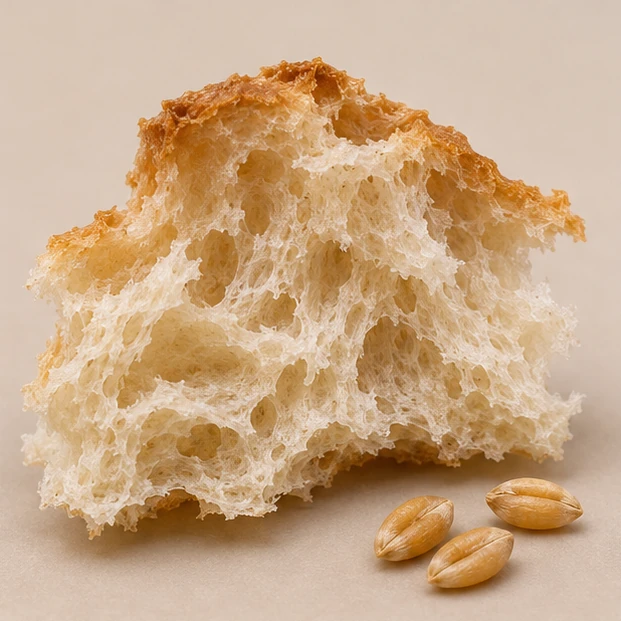
Salivary amylase is an enzyme in saliva that starts breaking long starch chains into smaller carbohydrates during chewing. Part of digestion therefore begins in the mouth. Examples of foods containing starch include bread, rice and potatoes.
Does salivary amylase digest every part of a meal?
It breaks particular bonds in starch, producing maltose and shorter chains among other products. Different enzymes digest fats and proteins. Most further carbohydrate digestion occurs in the small intestine.
02
Does everyone have the same amylase activity?
The amount and activity vary. In an experiment, starchy samples exposed to saliva rich in amylase lost their thickness faster. The way food feels during chewing also depends on its composition.
03
Does measuring saliva volume also measure amylase?
Collecting saliva over a set time measures its flow rate. This alone does not tell us the amount or activity of amylase. A specific assay is needed to measure the enzyme.
Knowledge in motion
Explained in 36 seconds.
Three steps. No audio. Each scene can also be selected manually.
Silent film with English on-screen text and simplified teaching images.
The major salivary glands release their secretions into the mouth. The parotid gland is one source of amylase-containing saliva.
Quick answersDoes salivary amylase digest every part of a meal?
It breaks particular bonds in starch, producing maltose and shorter chains among other products. Different enzymes digest fats and proteins. Most further carbohydrate digestion occurs in the small intestine.
Does everyone have the same amylase activity?
The amount and activity vary. In an experiment, starchy samples exposed to saliva rich in amylase lost their thickness faster. The way food feels during chewing also depends on its composition.
Does measuring saliva volume also measure amylase?
Collecting saliva over a set time measures its flow rate. This alone does not tell us the amount or activity of amylase. A specific assay is needed to measure the enzyme.
At the practice
At the examination
A question to ask
Is the planned saliva test assessing flow, buffering or a particular component?
If your mouth feels persistently dry, an assessment of possible causes is more informative than guessing your amylase activity.
Editorial research: . General information, not an individual diagnosis or treatment recommendation. Teaching illustrations are simplified and do not depict a patient case.
If you turn this on, this website stores which guides you open, separately from advertising preferences. The markers expire after a fixed 30-day period from activation. The list is not sent to us by this feature. You can turn it off here and delete the markers.
Other people using the same browser profile can also see the markers. German and English versions share one marker. Expired entries are removed the next time you open a page with this feature; deleting browser data may remove them earlier. “Viewed” means opened, not read or completed.
With your consent, we use Google Ads to attribute clicks on our appointment booking links and phone number to adverts. Google processes technical usage data and sets or reads cookies. Data may be processed in the USA. Advertising measurement does not load without your consent. Google Analytics and personalised advertising are not enabled. Google Maps loads separately when you choose to open the map. You can change your choice here at any time.