Which jaw does this framework fit?
It is a lower partial denture framework.

A sublingual bar joins the left and right sides of a removable lower partial denture. The metal connector follows the inner curve of the jaw. In the sublingual design it lies low in the space between the teeth and tongue.
For training & practice ↓
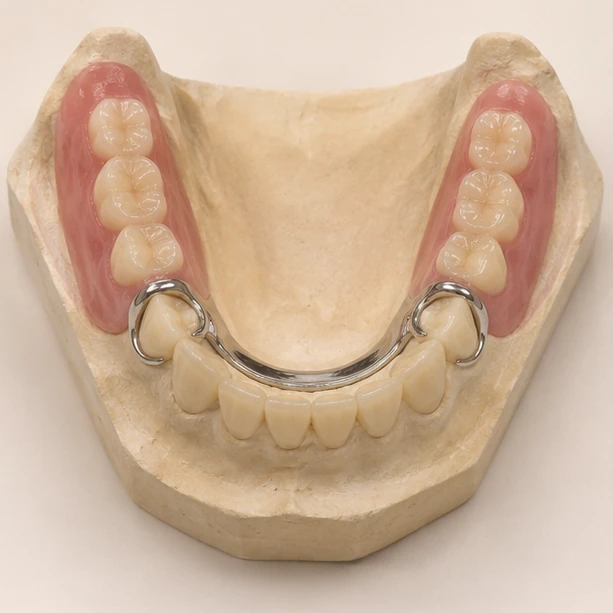
The bar follows the tongue side of the arch from one denture saddle to the other. It makes the replacement areas part of one framework.
The tongue and floor of the mouth move during speech and swallowing. Their movement matters when the clinician assesses the space for a bar.
A clasp may wrap around a natural tooth and resist removal. The major connector spans the distance between the two sides of the denture.
It is a lower partial denture framework.
Bring the denture and describe the movement that causes discomfort.
It extends further up the inner surfaces of the teeth.
Three steps. No audio.
Each scene can also be selected manually.

Silent film with English on-screen text and simplified teaching images.
A clasp engages an abutment tooth. The bar connects different parts across the arch.
Several connectors are possible. A conventional lingual bar has a more upright profile. A low, more horizontally oriented sublingual bar uses the available space differently.
A change can affect fit and rigidity. With the denture in place, show the clinician which tongue movement brings on the discomfort. Have the bar checked before any adjustment.
A lingual plate covers more of the tongue-facing tooth surfaces. The height of the floor of the mouth, remaining teeth and support needed influence the choice.
A question to bring along
Which movements should we check with my denture in place?
Bring the partial denture for assessment if the area beneath your tongue is sore.
Choose a dental appointmentAppointment selection at DoctolibA model shows the shape. The available space during movement is assessed in the mouth.
Editorial research: . General information, not an individual diagnosis or treatment recommendation. Teaching illustrations are simplified and do not depict a patient case.
If you turn this on, this website stores which guides you open, separately from advertising preferences. The markers expire after a fixed 30-day period from activation. The list is not sent to us by this feature. You can turn it off here and delete the markers.
Other people using the same browser profile can also see the markers. German and English versions share one marker. Expired entries are removed the next time you open a page with this feature; deleting browser data may remove them earlier. “Viewed” means opened, not read or completed.