Which sections does Super Floss have?
A threading end, a spongy section and a regular floss section.

Super Floss is an Oral-B product with a stiffened threading end, a spongy section and a regular floss section. The combination is intended for cleaning around bridges, braces and wider spaces, among other uses.
For training & practice ↓
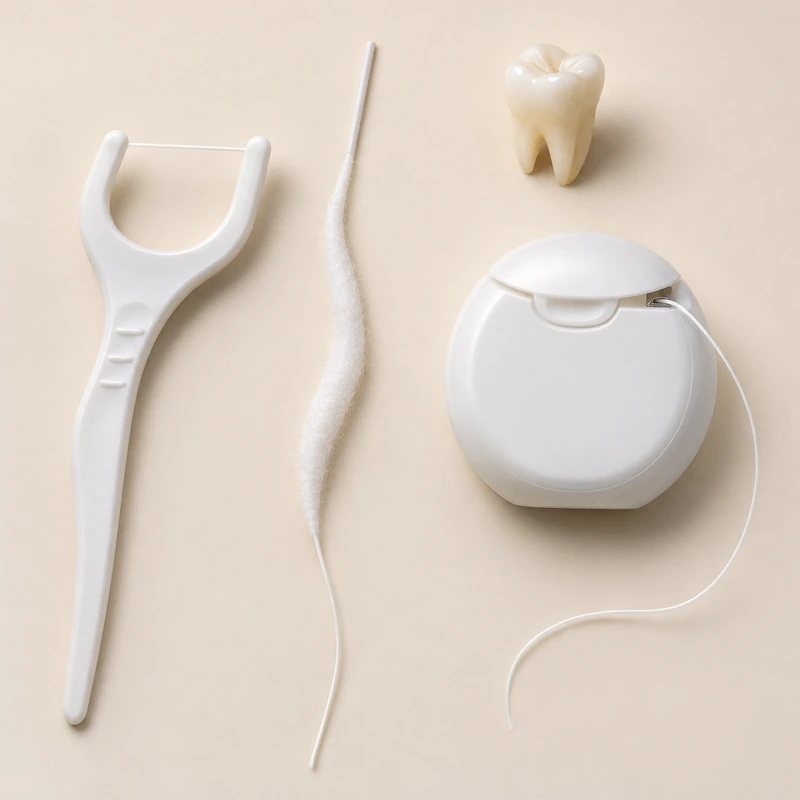
The stiffened end helps threading. The spongy part reaches suitable areas around appliances; the regular strand is used for flossing. Not every section is needed at every site.
At a bridge, floss cannot pass down through a connector as it does between two separate teeth. The sideways route beneath the bridge unit needs demonstration on your own restoration.
The strand should reach the intended surfaces without force. Repeated catching or shredding calls for assessment. Other aids may suit some spaces or structures better.
A threading end, a spongy section and a regular floss section.
No, use a suitable route without force.
No, the aid must fit the restoration’s design.
Three steps. No audio.
Each scene can also be selected manually.

Silent educational film with German on-screen text and simplified teaching images. Not a patient case or a promised treatment outcome. The full English explanation is available as text.
Super Floss combines different strand sections. A floss holder mainly provides a grip and does not automatically replace a threading end.
It is a product name. Other products may also have threading aids or different strand sections; the specific product instructions matter.
Not in every situation. The threading section assists certain access routes; ordinary floss may suit regular tight contacts.
Not universally. Restoration shape and surface determine suitable aids. Ask for an individual demonstration of the cleaning route.
Do not force it through a contact or pull it beneath tissue. Check the threading direction with the dental team; repeated problems need assessment.
Not generally. Size, access and reachable surfaces determine which aid is suitable at each site.
You can bring this question to your appointment:
Where should I thread the strand around my restoration, and which surfaces must it reach?
Discuss which cleaning approach fits your findings.
Discuss dental careAppointment selection at DoctolibSuper Floss combines different strand sections. A floss holder mainly provides a grip and does not automatically replace a threading end.
Editorial research: . General information, not an individual diagnosis or treatment recommendation. Teaching illustrations are simplified and do not depict a patient case.
If you turn this on, this website stores which guides you open, separately from advertising preferences. The markers expire after a fixed 30-day period from activation. The list is not sent to us by this feature. You can turn it off here and delete the markers.
Other people using the same browser profile can also see the markers. German and English versions share one marker. Expired entries are removed the next time you open a page with this feature; deleting browser data may remove them earlier. “Viewed” means opened, not read or completed.