What is it for?
Cleaning tight interdental spaces that it can safely reach.

Dental floss is a fine thread or tape used to clean the sides of teeth in tight spaces. It is guided along each tooth surface to remove soft deposits. It supplements brushing, particularly where an appropriately sized interdental brush cannot safely enter.
For training & practice ↓
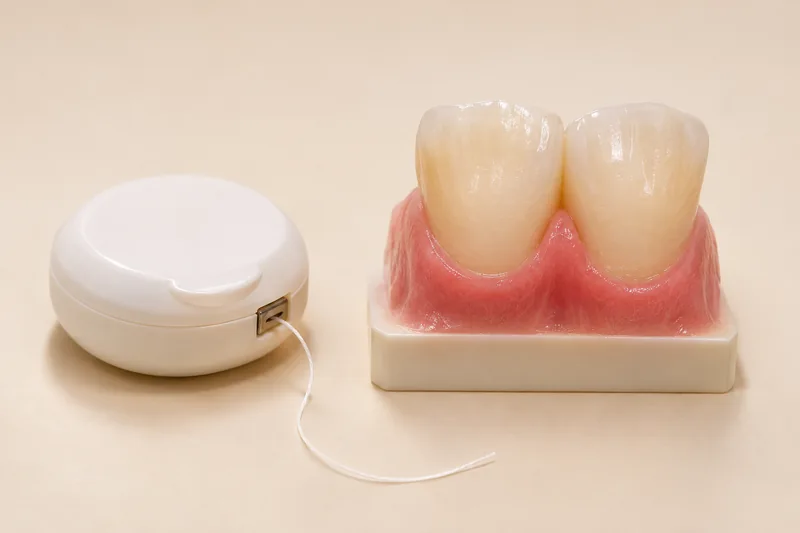
Teeth have surfaces facing their neighbours. Deposits can collect there even when no food is noticeably trapped.
Ease the floss through the contact and curve it into a C shape against one tooth. Then clean the neighbouring surface. Do not snap it into the gum.
An appropriately sized interdental brush may suit larger spaces better. Repeated bleeding, pain or floss that catches merits assessment of technique and the teeth.
Cleaning tight interdental spaces that it can safely reach.
A gentle technique suited to the site rather than high force.
If floss repeatedly tears, catches, causes injury or cannot reach an area easily.
Three steps. No audio.
Each scene can also be selected manually.

Silent educational film with German on-screen text and simplified teaching images. Not a patient case or a promised treatment outcome. The full English explanation is available below.
Teeth have surfaces facing their neighbours. Deposits can collect there even when no food is noticeably trapped.
Ease the floss through the contact and curve it into a C shape against one tooth. Then clean the neighbouring surface. Do not snap it into the gum.
An appropriately sized interdental brush may suit larger spaces better. Repeated bleeding, pain or floss that catches merits assessment of technique and the teeth.
Floss can suit tight contacts that a brush cannot enter safely. For sufficiently open spaces, appropriately selected brushes are often useful. Tool choice depends on the site.
No. Cleaning also targets soft attached deposits. A space may need cleaning even when nothing obvious is stuck there.
Generally daily with a suitable tool, in addition to brushing. The areas that need floss or brushes can be demonstrated and practised.
Possible explanations include inflamed gums or an injuring technique. Repeated bleeding needs assessment; extra force is not the solution.
An editorially suggested question for a discussion with Dr med dent Niusha Barahmand Pour:
Where does floss fit my teeth, and where would another tool be more suitable?
Interdental care should work in everyday life. A brief demonstration can help.
Ask about interdental cleaningAppointment selection at DoctolibFloss can suit tight contacts that a brush cannot enter safely. For sufficiently open spaces, appropriately selected brushes are often useful. Tool choice depends on the site.
Editorial research: . General information, not an individual diagnosis or treatment recommendation. Teaching illustrations are simplified and do not depict a patient case.