Where does it form?
Inside the tooth at the pulp boundary.

Tertiary dentine is locally formed dentine-like hard tissue at the pulp boundary in response to irritation or injury, such as decay. When the original dentine-forming cells survive, the response is called reactionary dentine; after their loss, reparative tissue may form. This response can help shield the pulp but neither removes the cause nor guarantees that the pulp is healthy.
For training & practice ↓
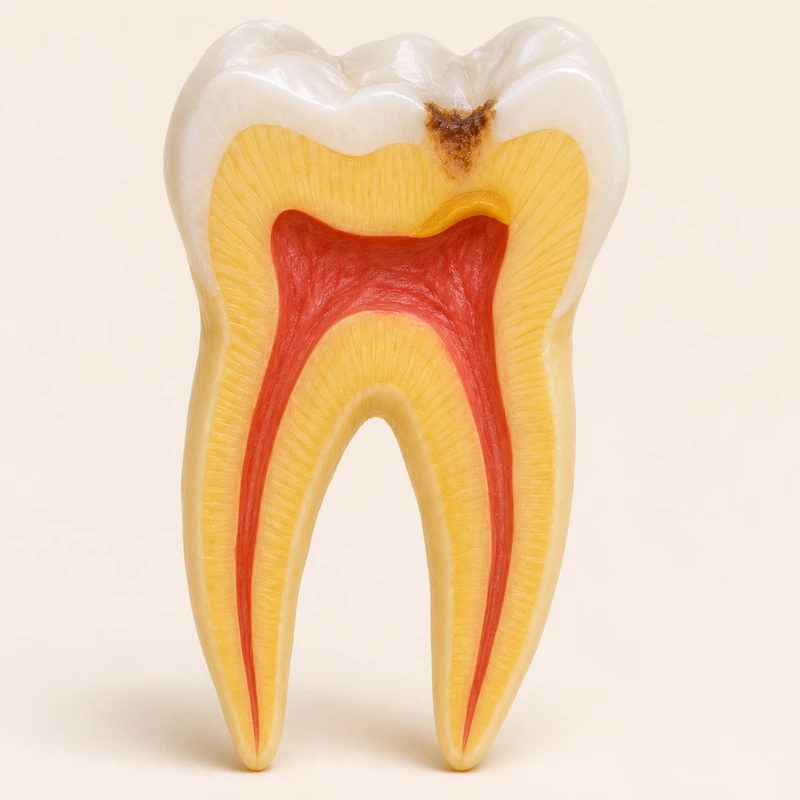
Additional hard tissue may form on the pulp side beneath an affected area. This response occurs inside the tooth. It does not replace missing enamel on the outer surface.
Surviving odontoblasts can produce reactionary dentine. After they are lost, other cells may produce reparative hard tissue. Its structure need not match the original dentine.
Additional hard tissue does not prove that decay has healed. Symptoms, sensibility testing and clinical findings are considered together. Addressing the cause remains essential.
Inside the tooth at the pulp boundary.
In response to irritation or injury.
No; the cause still needs assessment.
Three steps. No audio.
Each scene can also be selected manually.

Silent educational film with German on-screen text and simplified teaching images. Not a patient case or a promised treatment outcome. The full English explanation is available as text.
Tertiary dentine is newly formed by cells inside the tooth. Remineralisation means minerals are redeposited in existing demineralised tooth tissue.
No. Tertiary dentine forms towards the pulp and does not rebuild the external tooth shape. A carious lesion still needs appropriate assessment and management.
No. Secondary dentine forms slowly during later life. Tertiary dentine is a local response to a particular stimulus.
No. A hard-tissue response alone cannot reliably show the current inflammatory state. Few symptoms do not rule out a cause requiring treatment.
You can bring this question to your appointment:
Which findings suggest that the pulp can be preserved, and how will the cause of irritation be managed?
An individual assessment can clarify the findings and whether referral is needed.
Arrange an assessmentAppointment selection at DoctolibTertiary dentine is newly formed by cells inside the tooth. Remineralisation means minerals are redeposited in existing demineralised tooth tissue.
Editorial research: . General information, not an individual diagnosis or treatment recommendation. Teaching illustrations are simplified and do not depict a patient case.
If you turn this on, this website stores which guides you open, separately from advertising preferences. The markers expire after a fixed 30-day period from activation. The list is not sent to us by this feature. You can turn it off here and delete the markers.
Other people using the same browser profile can also see the markers. German and English versions share one marker. Expired entries are removed the next time you open a page with this feature; deleting browser data may remove them earlier. “Viewed” means opened, not read or completed.