What is raised?
The future restorative margin.

Deep margin elevation uses restorative material to build the deep margin of a defect up towards the chewing surface. The margin for a later indirect restoration becomes more accessible. The gum itself stays in place.
For training & practice ↓
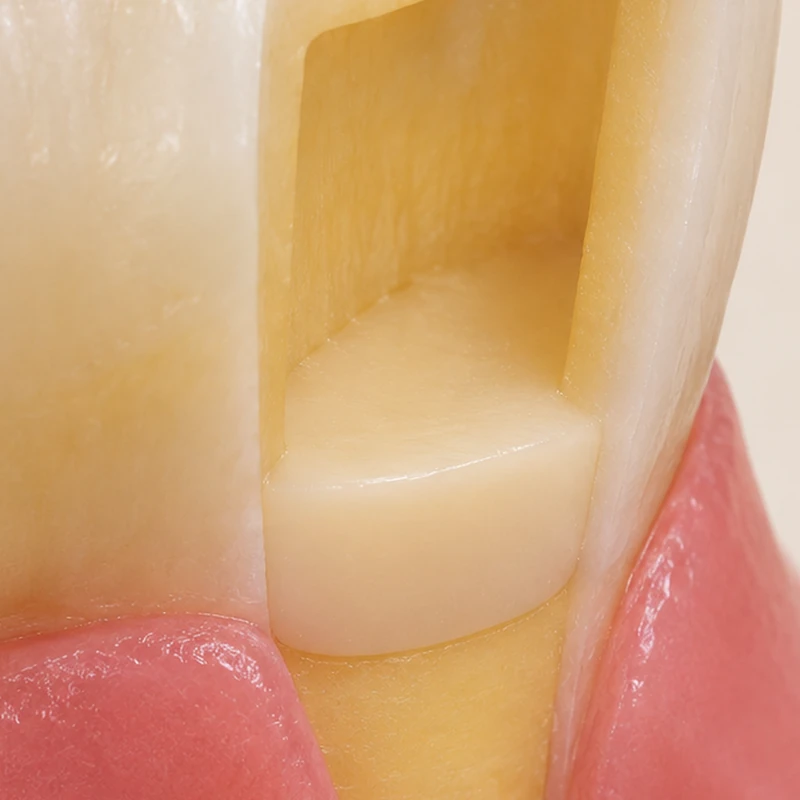
A defect between teeth may extend close to the gum. Its lower margin must be accessible for the build-up.
A matrix contains the unset restorative material. It helps shape a smooth contour that can be cleaned.
The pale material raises the floor of the proximal box. The further restoration can be planned on this build-up.
The future restorative margin.
Access and tissue health limit the technique.
Contour, cleansability and gum health.
Three steps. No audio.
Each scene can also be selected manually.

Silent film with English on-screen text and simplified teaching images.
The elevated margin should blend smoothly with the tooth. Material that projects sideways can impede cleaning.
Elevation builds up the defect with restorative material. Surgical crown lengthening changes the soft tissue level and may also involve bone.
The original margin must be accessible, sealable and adequately isolated. Its relation to the attachment of the tissues around the tooth also matters. A very deep defect may require another approach.
The dentist checks the contour, access for cleaning and bleeding of the adjacent gum. Bleeding alone does not prove that a build-up is faulty.
A question to bring along
Can the original margin in my tooth be reached and kept adequately clean and dry?
For a deep defect between teeth, discuss the findings, alternatives and long-term cleaning.
Choose an appointmentAppointment selection at DoctolibThe randomised study followed selected root-treated posterior teeth for twelve months. It does not establish suitability for all deep defects.
Editorial research: . General information, not an individual diagnosis or treatment recommendation. Teaching illustrations are simplified and do not depict a patient case.
If you turn this on, this website stores which guides you open, separately from advertising preferences. The markers expire after a fixed 30-day period from activation. The list is not sent to us by this feature. You can turn it off here and delete the markers.
Other people using the same browser profile can also see the markers. German and English versions share one marker. Expired entries are removed the next time you open a page with this feature; deleting browser data may remove them earlier. “Viewed” means opened, not read or completed.