Is it made of bone?
Yes, with mucosa covering it.

A torus mandibularis is a benign bony prominence on the inner surface of the lower jaw, usually near the premolars. It may occur on both sides and often causes no symptoms. The name applies to an assessed finding, not to every swelling under the tongue.
For training & practice ↓
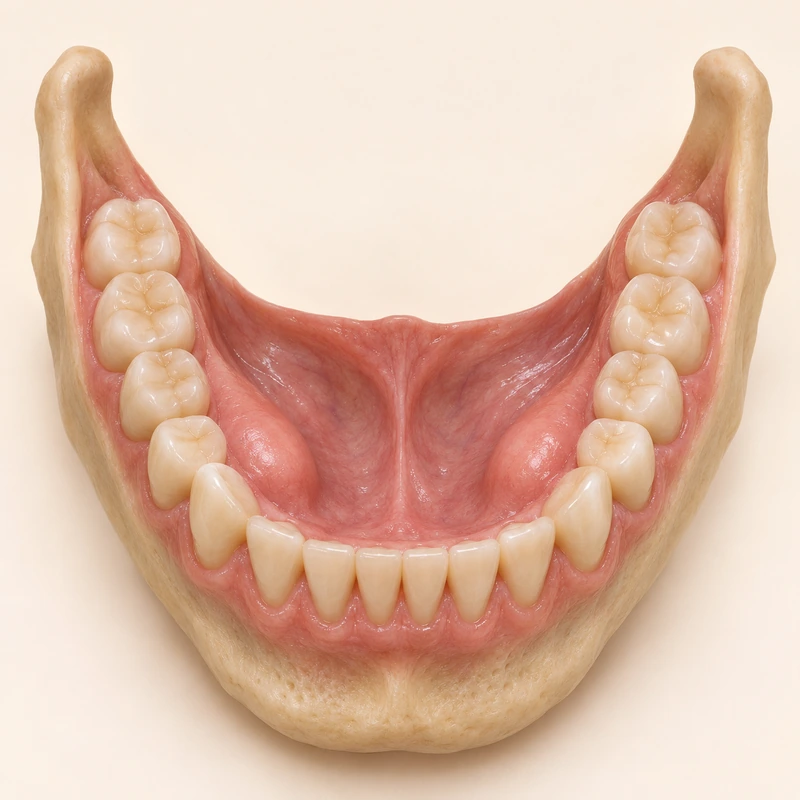
The prominence arises from the inner jaw bone rather than a salivary gland. Examination assesses its location, firmness and covering mucosa.
Removal is usually unnecessary for a typical symptom-free torus. The overlying tissue and available space still matter when planning dental care.
A torus can complicate the design of a removable denture. Whether adjustment is sufficient or surgery is appropriate is discussed individually.
Yes, with mucosa covering it.
Often not when the diagnosis is confirmed and it causes no symptoms.
It may affect the available space and denture support.
Three steps. No audio.
Each scene can also be selected manually.

Silent educational film with German on-screen text and simplified teaching images. Not a patient case or a promised treatment outcome. The full English explanation is available as text.
A mandibular torus lies on the inside of the lower jaw. A palatal torus lies in the midline of the hard palate. Both are particular bony prominences, but at different sites.
No. Shape and size can vary. A newly noticed or changing area should still be professionally assessed.
No. A torus is made of jaw bone. A salivary stone lies in a salivary gland or its duct, with different causes and treatment.
If pain, recurrent sores, denture problems or a marked change develops. Do not try to cut or file it yourself.
You can bring this question to your appointment:
Does the shape of my lower jaw need special consideration for cleaning or denture design?
An individual examination can clarify the findings and suitable next steps.
Arrange an assessmentAppointment selection at DoctolibA mandibular torus lies on the inside of the lower jaw. A palatal torus lies in the midline of the hard palate. Both are particular bony prominences, but at different sites.
Editorial research: . General information, not an individual diagnosis or treatment recommendation. Teaching illustrations are simplified and do not depict a patient case.
If you turn this on, this website stores which guides you open, separately from advertising preferences. The markers expire after a fixed 30-day period from activation. The list is not sent to us by this feature. You can turn it off here and delete the markers.
Other people using the same browser profile can also see the markers. German and English versions share one marker. Expired entries are removed the next time you open a page with this feature; deleting browser data may remove them earlier. “Viewed” means opened, not read or completed.