What is it made of?
Bone covered by oral mucosa.

An exostosis is a benign bony projection from the surface of a bone. In the mouth, these growths may occur on the jaws; palatal and mandibular tori are particular forms. An examination is needed to establish whether a hard area you can feel is actually an exostosis.
For training & practice ↓
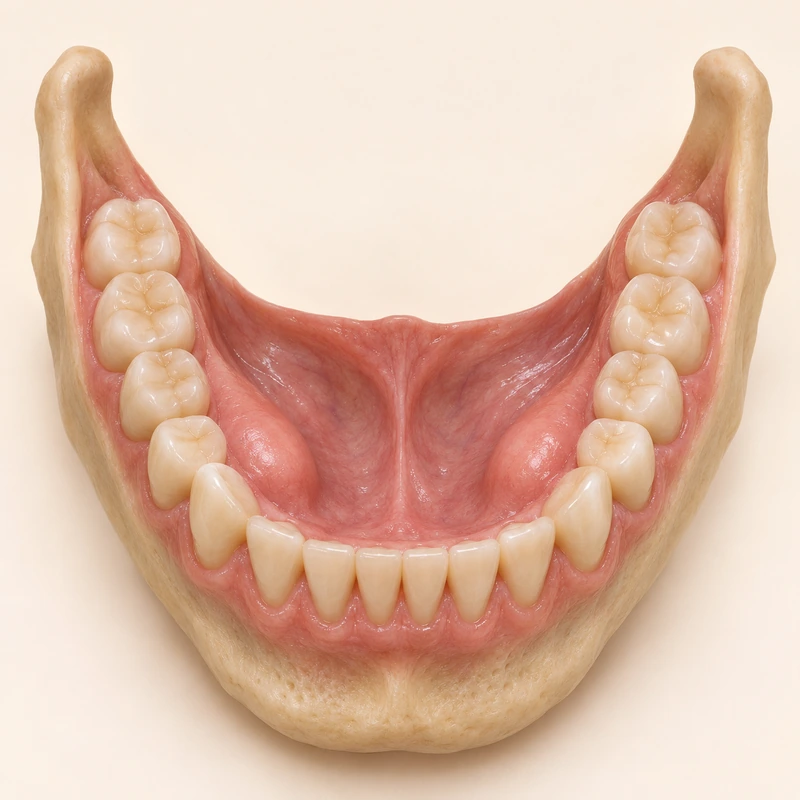
The projection consists of bone covered by oral mucosa. Feeling a hard lump alone does not establish its identity.
A confirmed, uncomplicated exostosis often needs no treatment. What matters is whether it affects the overlying tissue or a planned denture, for example.
Pain, a sore surface or a marked change should be examined. Removal is considered by weighing the specific benefit against the risks of surgery.
Bone covered by oral mucosa.
No. Assessment and observation are often sufficient.
If pain, ulceration or a noticeable change develops.
Three steps. No audio.
Each scene can also be selected manually.

Silent educational film with German on-screen text and simplified teaching images. Not a patient case or a promised treatment outcome. The full English explanation is available as text.
Exostosis is the broader term for a bony outgrowth. Torus mandibularis and torus palatinus name characteristic forms at particular sites in the mouth.
Often it does not. Removal may be considered for difficulties with a denture, for example; simply having a bony projection is not an automatic reason for surgery.
No. Other bony and non-bony lesions exist. New or uncertain findings are examined and investigated further when needed.
No. Massage cannot eliminate a bony projection. Firm pressure may irritate the mucosa over it.
You can bring this question to your appointment:
Is the bony projection clearly identified, and does it interfere with the mucosa or planned denture?
An individual examination can clarify the findings and suitable next steps.
Arrange an assessmentAppointment selection at DoctolibExostosis is the broader term for a bony outgrowth. Torus mandibularis and torus palatinus name characteristic forms at particular sites in the mouth.
Editorial research: . General information, not an individual diagnosis or treatment recommendation. Teaching illustrations are simplified and do not depict a patient case.
If you turn this on, this website stores which guides you open, separately from advertising preferences. The markers expire after a fixed 30-day period from activation. The list is not sent to us by this feature. You can turn it off here and delete the markers.
Other people using the same browser profile can also see the markers. German and English versions share one marker. Expired entries are removed the next time you open a page with this feature; deleting browser data may remove them earlier. “Viewed” means opened, not read or completed.