What to notice?
Situations, tension and symptoms.

Awake bruxism is chewing-muscle activity while awake, such as repeated or sustained tooth contact, clenching or bracing the jaw. Not every episode causes damage. Symptoms, excessive loading and consequences determine its clinical relevance.
For training & practice ↓
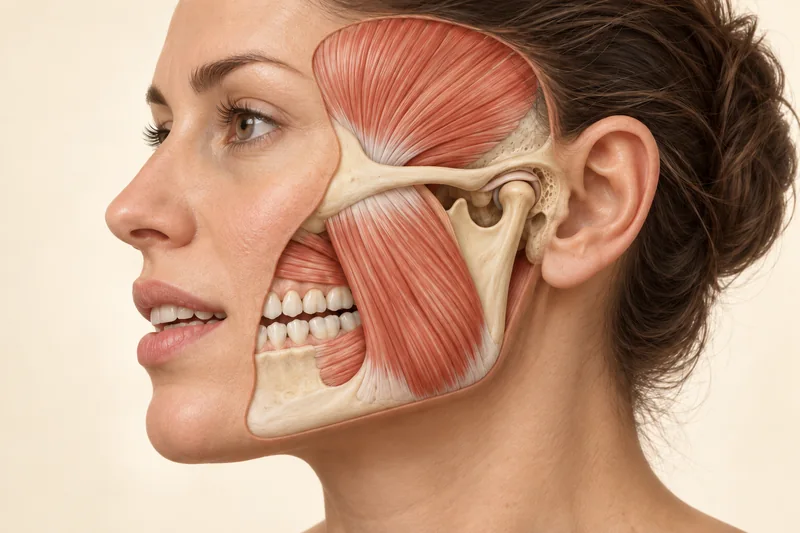
During concentrated work the teeth may remain together or the muscles may stay tense. Audible grinding is not required.
Occasional conscious observation may reveal situations in which it happens. These observations support a discussion; they are not a diagnosis or risk score.
Pain, tooth wear and other possible causes are examined. Education and suitable behavioural measures may form part of an individual plan.
Situations, tension and symptoms.
Muscles, joints, teeth and alternative explanations.
Labelling every normal tooth contact as disease.
Three steps. No audio.
Each scene can also be selected manually.

Silent educational film with German on-screen text and simplified teaching images. Not a patient case or a promised treatment outcome. The full English explanation is available below.
During concentrated work the teeth may remain together or the muscles may stay tense. Audible grinding is not required.
Occasional conscious observation may reveal situations in which it happens. These observations support a discussion; they are not a diagnosis or risk score.
Pain, tooth wear and other possible causes are examined. Education and suitable behavioural measures may form part of an individual plan.
They differ by the state in which muscle activity occurs. Tension noticed during the day does not prove activity during sleep.
No. Stress can contribute, but several influences are possible. Clenching alone cannot identify a single cause.
No. Whether protection or other measures are appropriate depends on findings and symptoms.
Discuss the timing with the prescribing clinician. Do not stop prescribed medication on your own.
Editorially suggested question to discuss with Dr Niusha Barahmand Pour:
Which observations matter, and which measures could fit my daily routine?
Repeated clenching with discomfort can be discussed in a focused appointment.
Discuss clenching and jaw discomfortAppointment selection at DoctolibThey differ by the state in which muscle activity occurs. Tension noticed during the day does not prove activity during sleep.
Editorial research: . General information, not an individual diagnosis or treatment recommendation. Teaching illustrations are simplified and do not depict a patient case.