What carries water to the instrument?
The dental unit waterline.

Dental unit waterlines supply devices such as handpieces, air-water syringes and ultrasonic scalers. Microbial films can develop in the narrow tubing. Appropriate system maintenance and water-quality monitoring therefore go together.
For training & practice ↓
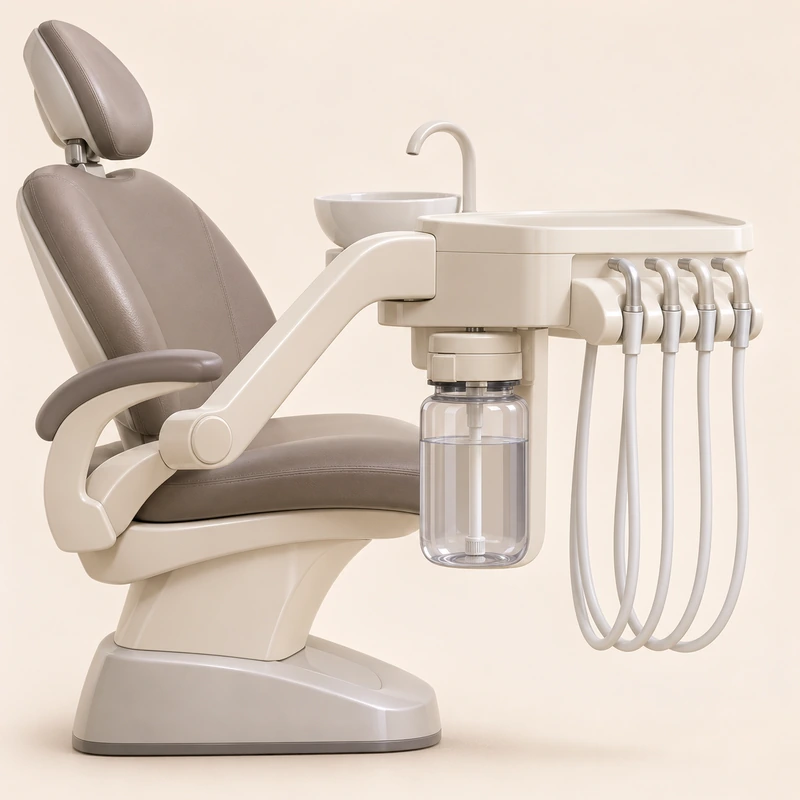
Water travels through narrow tubing before reaching the instrument. The quality at the outlet therefore also depends on the condition of the system.
A layer of microorganisms can form on the inner surfaces. A separate water reservoir alone does not prevent this.
Maintenance and appropriate checks follow the system's requirements, manufacturer guidance and applicable rules. Appearance alone cannot establish microbiological quality.
The dental unit waterline.
A film of attached microorganisms.
Through appropriate monitoring alongside maintenance.
Three steps. No audio.
Each scene can also be selected manually.

Silent educational film with German on-screen text and simplified teaching images. Not a patient case or a promised treatment outcome. The full English explanation is available as text.
Waterline hygiene concerns the water system and its output. Instrument reprocessing follows a separate procedure suited to the instrument.
Water travels through narrow tubing before reaching the instrument. The quality at the outlet therefore also depends on the condition of the system.
A layer of microorganisms can form on the inner surfaces. A separate water reservoir alone does not prevent this.
Maintenance and appropriate checks follow the system's requirements, manufacturer guidance and applicable rules. Appearance alone cannot establish microbiological quality.
Routine treatment and procedures requiring sterile irrigation have different requirements. Sterile irrigant also requires an appropriate delivery pathway.
Waterline hygiene concerns the water system and its output. Instrument reprocessing follows a separate procedure suited to the instrument.
A question you could ask
What type of water or irrigant is used at this stage?
If you have a question about treatment water, ask about the distinction between routine cooling and sterile irrigation.
Call the practice · 0221 669 401 80Telephone contactWaterline hygiene concerns the water system and its output. Instrument reprocessing follows a separate procedure suited to the instrument.
Editorial research: . General information, not an individual diagnosis or treatment recommendation. Teaching illustrations are simplified and do not depict a patient case.
If you turn this on, this website stores which guides you open, separately from advertising preferences. The markers expire after a fixed 30-day period from activation. The list is not sent to us by this feature. You can turn it off here and delete the markers.
Other people using the same browser profile can also see the markers. German and English versions share one marker. Expired entries are removed the next time you open a page with this feature; deleting browser data may remove them earlier. “Viewed” means opened, not read or completed.