What supports this coping?
A treated natural tooth root.

A post-retained root coping covers a retained, shortened tooth root. A post anchors the coping inside the prepared root canal. The coping may support an overdenture or carry a separate retention attachment.
For training & practice ↓
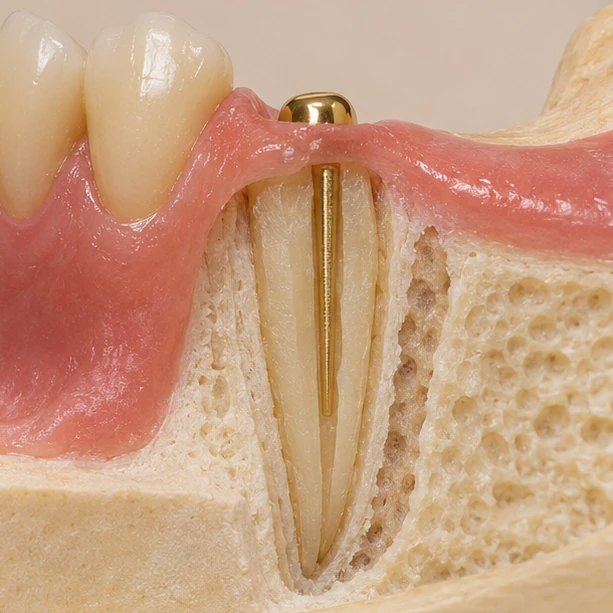
Some of the natural tooth remains beneath the gum. Its suitability depends in part on the health of the root and its periodontal support.
The post lies inside the root canal. The coping covers the shortened root surface and gives it a defined contour beneath the denture.
An overdenture fits over the abutment. In some designs an attachment on the coping engages a matching component in the denture.
A treated natural tooth root.
A matching attachment can increase resistance to removal.
The removable denture and the exposed abutment.
Three steps. No audio.
Each scene can also be selected manually.

Silent film with English on-screen text and simplified teaching images.
Here a low abutment remains beneath a removable denture. A post-and-core restoration may instead support a fixed crown.
The foundation differs. A root coping is anchored to a natural tooth root. An implant abutment connects to a surgically placed implant.
A coping can have a low, smooth profile. An attachment is added only when the denture design calls for one.
The coping margin, remaining tooth, gums and retention can change. Access to the area matters for cleaning.
A question to bring along
How will the root be reviewed, and how can I clean the coping margin?
Restorative planning includes the condition and cleanability of each potential root abutment.
Choose a dental appointmentAppointment selection at DoctolibAn examination can estimate the outlook for an individual abutment. It cannot establish a fixed lifespan.
Editorial research: . General information, not an individual diagnosis or treatment recommendation. Teaching illustrations are simplified and do not depict a patient case.
If you turn this on, this website stores which guides you open, separately from advertising preferences. The markers expire after a fixed 30-day period from activation. The list is not sent to us by this feature. You can turn it off here and delete the markers.
Other people using the same browser profile can also see the markers. German and English versions share one marker. Expired entries are removed the next time you open a page with this feature; deleting browser data may remove them earlier. “Viewed” means opened, not read or completed.