Why does this still matter for older fillings?
Even when no new amalgam is placed, removing an old filling or a tooth containing one may release particles. Collection remains relevant to that work.

An amalgam separator is a device in a dental practice’s wastewater system. It collects solid amalgam particles carried away in suction water so that they can be disposed of separately. It operates downstream from the treatment area.
For training & practice ↓
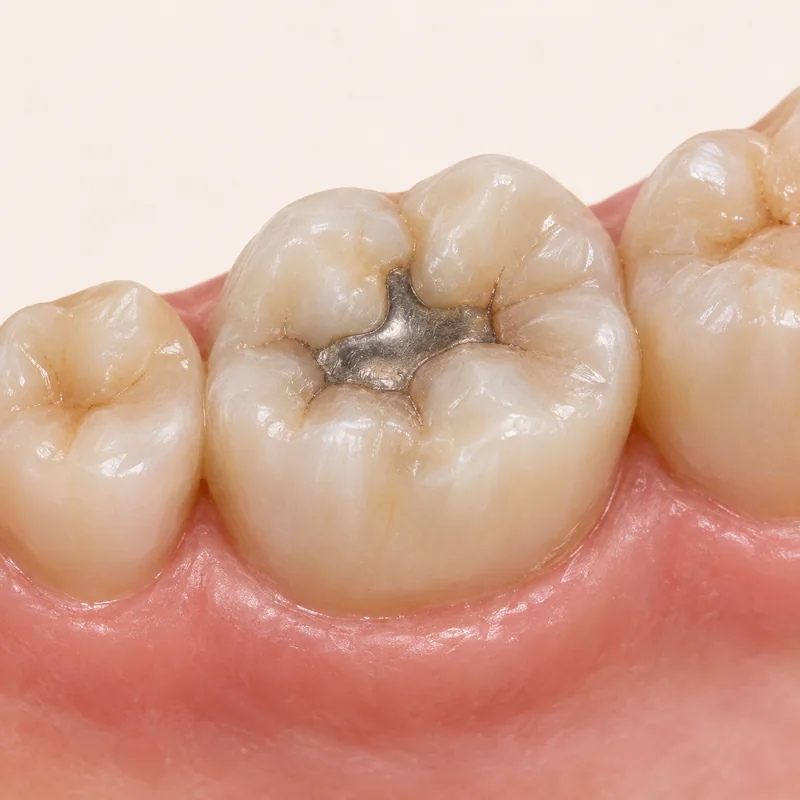
When an older amalgam filling is removed, small solid particles can enter suction water.
This illustrative device has hose connections and a collection chamber. Actual designs vary.
The condition of the restoration and tooth guides whether treatment is needed.
When an older amalgam filling is removed, small solid particles can enter suction water.
This illustrative device has hose connections and a collection chamber. Actual designs vary.
The condition of the restoration and tooth guides whether treatment is needed.
Even when no new amalgam is placed, removing an old filling or a tooth containing one may release particles. Collection remains relevant to that work.
The suction tip draws fluid and debris away from the mouth. Further along, the separator retains much of the solid amalgam in the wastewater. The collected waste goes for separate disposal.
Separation concerns waste handling. A decision to repair or replace an existing filling depends on its condition, for example a fracture or decay at the margin.
Three steps. No audio.
Each scene can also be selected manually.

Silent film with English on-screen text and simplified teaching images.
The tip removes fluid from the mouth. The separator sits in the wastewater system and retains particles.
Even when no new amalgam is placed, removing an old filling or a tooth containing one may release particles. Collection remains relevant to that work.
The suction tip draws fluid and debris away from the mouth. Further along, the separator retains much of the solid amalgam in the wastewater. The collected waste goes for separate disposal.
Separation concerns waste handling. A decision to repair or replace an existing filling depends on its condition, for example a fracture or decay at the margin.
A question to ask
What finding supports repairing or replacing my existing filling?
A dentist can assess a damaged or painful filling.
Choose an appointmentAppointment selection at DoctolibSeparating solids in wastewater, clinical precautions and deciding whether a filling needs replacing are separate questions.
Editorial research: . General information, not an individual diagnosis or treatment recommendation. Teaching illustrations are simplified and do not depict a patient case.
If you turn this on, this website stores which guides you open, separately from advertising preferences. The markers expire after a fixed 30-day period from activation. The list is not sent to us by this feature. You can turn it off here and delete the markers.
Other people using the same browser profile can also see the markers. German and English versions share one marker. Expired entries are removed the next time you open a page with this feature; deleting browser data may remove them earlier. “Viewed” means opened, not read or completed.