Who may find this relevant?
People with amalgam fillings or questions about restorative materials.

Dental amalgam is a metallic filling material containing mercury and other metals. Since 1 January 2025, its use for new dental treatment has generally been prohibited in the EU, with a narrow exception for strictly necessary, patient-specific medical needs. An existing intact filling does not therefore automatically need removal. Information checked: 2 November 2026.
For training & practice ↓
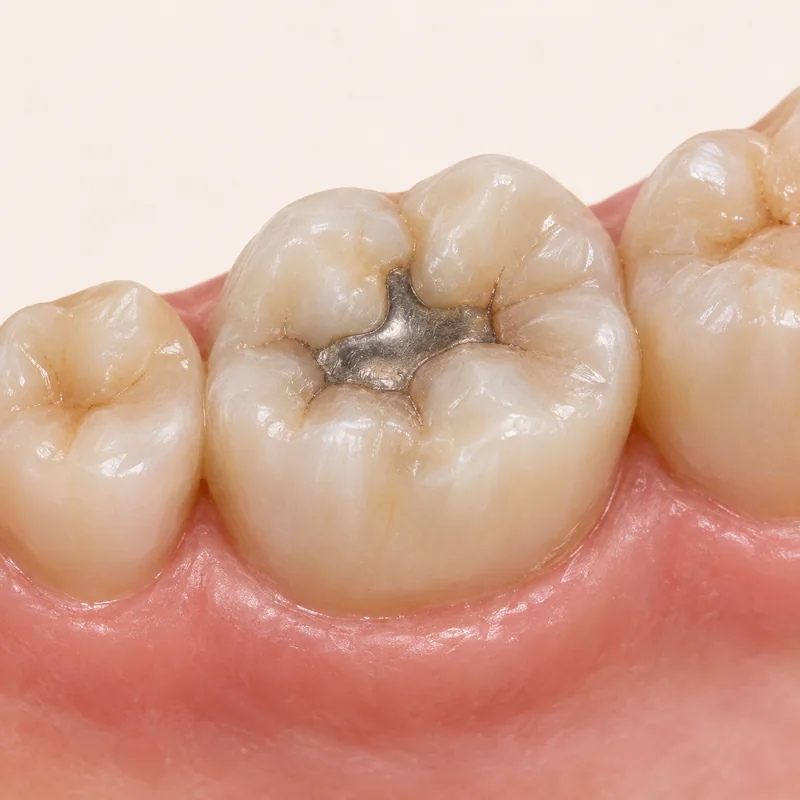
A grey filling may be amalgam. Decisions about an existing restoration depend particularly on its seal, stability, possible decay and symptoms, rather than colour or age alone.
The EU measure forms part of reducing environmental mercury pollution. It is not an instruction to replace every existing filling. The medical exception for new use is not an unrestricted routine option.
For damage or other justified concerns, repair or replacement can be discussed. Findings, preservation of tooth tissue and a suitable replacement material guide the decision; no general detoxification benefit is promised.
People with amalgam fillings or questions about restorative materials.
The filling, its margins, tooth tissue and any symptoms.
Grinding, drilling or removing a filling. New pain or breakage needs assessment.
Three steps. No audio.
Each scene can also be selected manually.

Silent educational film with German on-screen text and simplified teaching images. Not a patient case or a promised treatment outcome. The full English explanation is available below.
A grey filling may be amalgam. Decisions about an existing restoration depend particularly on its seal, stability, possible decay and symptoms, rather than colour or age alone.
The EU measure forms part of reducing environmental mercury pollution. It is not an instruction to replace every existing filling. The medical exception for new use is not an unrestricted routine option.
For damage or other justified concerns, repair or replacement can be discussed. Findings, preservation of tooth tissue and a suitable replacement material guide the decision; no general detoxification benefit is promised.
The restriction concerns using dental amalgam for treatment. It does not create a general requirement to remove existing intact fillings.
Yes. The new-use restriction does not require removal of existing fillings. Individual symptoms or specific findings need separate assessment.
No. The condition of the filling and surrounding tooth matters. A date alone is not a reason to replace it.
Suitability depends on the defect’s size, location and loading, among other factors. Material properties and possible options are discussed in context; none suits every situation.
An editorially suggested question for a discussion with Dr med dent Niusha Barahmand Pour:
Is there a specific finding in this filling that makes a change necessary?
Unsure about an old filling? A review can establish whether it still functions and whether any action is necessary.
Have an existing filling reviewedAppointment selection at DoctolibThe restriction concerns using dental amalgam for treatment. It does not create a general requirement to remove existing intact fillings.
Editorial research: . General information, not an individual diagnosis or treatment recommendation. Teaching illustrations are simplified and do not depict a patient case.