
Dental knowledge · Did you know?
Snoring appliances: how they work, suitability and finding the right setting
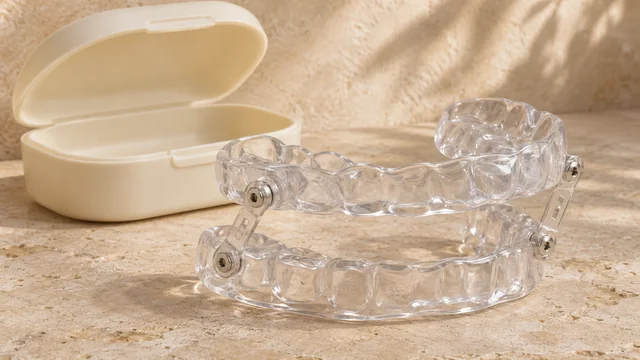
A snoring appliance holds the lower jaw in an individually determined forward position during sleep. This can help keep the upper airway more open and stable. Whether it is appropriate and effective for an individual cannot be judged from snoring sounds alone. Medical assessment of breathing and a dental examination come before fitting, followed by adjustment and follow-up care.
Published on
 AI-generated
In this guide
What can change in the throat
The lower jaw and tongue are functionally connected to soft tissues of the upper airway. Holding the lower jaw forward can increase space in the throat. In suitable people, this may reduce tissue vibration and airway collapse. The appliance does not act directly on the soft palate, and it does not supply air like a positive airway pressure device.
The term mandibular advancement device describes this principle: advancement means moving forward. More advancement is not automatically better. A suitable position needs to balance breathing, tolerance and jaw function. This is why guided adjustment forms part of treatment.
IQWiG: Behandlung einer obstruktiven Schlafapnoe · AADSM: Dental Sleep Medicine Standards for Screening, Treatment, and Management of Sleep-Related Breathing Disorders in Adults Using Oral Appliance Therapy, 2025
Why a grinding guard is different
A guard used for tooth grinding can have a different purpose and design. Wearing it at night does not make it a treatment for snoring or sleep apnoea. The treatment described here requires a device designed to hold the intended jaw position and allow controlled adjustment.
Custom-made adjustable devices also differ from generic appliances bought without assessment. Self-fitting does not replace investigating the cause or examining the teeth. Bring any existing appliances to the consultation so that their purpose and condition can be reviewed.
AASM/AADSM: Clinical Practice Guideline for the Treatment of Obstructive Sleep Apnea and Snoring with Oral Appliance Therapy, 2015 · G-BA: Änderung der Behandlungs-Richtlinie zur Unterkieferprotrusionsschiene, Beschluss vom 6. Mai 2021
Who might be suitable for an appliance?
An appliance can be an option for troublesome snoring without sleep apnoea after appropriate assessment. In diagnosed obstructive sleep apnoea, the decision depends on factors including severity, symptoms, other conditions and previous treatment. Do not independently replace prescribed CPAP treatment with an appliance.
The dental assessment considers anchorage, the condition of teeth and gums, and jaw movement or symptoms. Existing restorations and the ability to insert, remove and clean the appliance matter too. A single feature described on a website cannot confirm or rule out individual suitability.
AASM/AADSM: Clinical Practice Guideline for the Treatment of Obstructive Sleep Apnea and Snoring with Oral Appliance Therapy, 2015 · IQWiG: Behandlung einer obstruktiven Schlafapnoe · AADSM: Dental Sleep Medicine Standards for Screening, Treatment, and Management of Sleep-Related Breathing Disorders in Adults Using Oral Appliance Therapy, 2025
From an idea to a treatment pathway that can be checked
The sequence depends on the findings and coordination between the professionals involved. Responsibilities should be clear: who assesses breathing during sleep, who fits the appliance and who checks its effect? The steps below describe the principle, not a guaranteed process or fixed number of appointments at SMD.
- Assessment: a clinician evaluates symptoms, observations and, where indicated, sleep measurements.
- Dental examination: teeth, supporting tissues, existing restorations and jaw function are assessed.
- Making and fitting the device: individual impressions or digital records and a bite registration provide the basis; fit and handling are checked.
- Adjustment: advancement is changed according to the agreed plan while symptoms and tolerance are monitored.
- Effectiveness and follow-up: in sleep apnoea, the treatment effect is medically assessed; teeth and bite continue to be monitored over time.
G-BA: Änderung der Behandlungs-Richtlinie zur Unterkieferprotrusionsschiene, Beschluss vom 6. Mai 2021 · AADSM: Dental Sleep Medicine Standards for Screening, Treatment, and Management of Sleep-Related Breathing Disorders in Adults Using Oral Appliance Therapy, 2025
Less noise is a clue, not proof
A quieter night can make a real difference to life together. With sleep apnoea, however, breathing disturbances also need adequate treatment. Feeling better or receiving reassuring feedback from a partner is not enough on its own. Appropriate follow-up measurements assess the effect of the appliance at its adjusted setting.
If symptoms persist, the plan is reviewed. This may involve readjustment or a different treatment. Changes can also occur later, for example after new dental work, changes in body weight or a poorer fit. Scheduled reviews are therefore part of care, not merely an opportunity for repairs.
AASM/AADSM: Clinical Practice Guideline for the Treatment of Obstructive Sleep Apnea and Snoring with Oral Appliance Therapy, 2015 · National Heart, Lung, and Blood Institute: Living With Sleep Apnea
Questions worth asking before deciding
A useful consultation covers benefits and limitations as well as daily use. Ask how suitability is assessed, how acclimatisation is managed and whom to contact about pain or returning snoring. Ask about follow-up and cost planning too. A medical indication and potential reimbursement are separate questions.
AADSM: Dental Sleep Medicine Standards for Screening, Treatment, and Management of Sleep-Related Breathing Disorders in Adults Using Oral Appliance Therapy, 2025 · G-BA: Änderung der Behandlungs-Richtlinie zur Unterkieferprotrusionsschiene, Beschluss vom 6. Mai 2021
Common questions
Will the appliance work on the first night?
This cannot be promised. Acclimatisation and controlled adjustment may be needed. With sleep apnoea, medically assessed effectiveness matters as well as sound.
AADSM: Dental Sleep Medicine Standards for Screening, Treatment, and Management of Sleep-Related Breathing Disorders in Adults Using Oral Appliance Therapy, 2025 · AASM/AADSM: Clinical Practice Guideline for the Treatment of Obstructive Sleep Apnea and Snoring with Oral Appliance Therapy, 2015
Can I simply advance the lower jaw further?
Not on your own judgement. More advancement can cause discomfort and does not automatically improve breathing. Changes should follow the individual treatment plan.
Does health insurance cover every snoring appliance?
No. Statutory provision for obstructive sleep apnoea has defined requirements and a coordinated medical and dental pathway. Clarify the applicable cost arrangements before treatment.
Do jaw problems always rule out an appliance?
There is no universal answer. Jaw movement, the type of symptoms and potential loading need dental assessment. An online description cannot replace it.
AADSM: Dental Sleep Medicine Standards for Screening, Treatment, and Management of Sleep-Related Breathing Disorders in Adults Using Oral Appliance Therapy, 2025 · G-BA: Änderung der Behandlungs-Richtlinie zur Unterkieferprotrusionsschiene, Beschluss vom 6. Mai 2021
Related reading
Sources and further reading
Research and editorial date: 7 November 2026. General information; individual findings and recommendations require an examination.
- IQWiG: Behandlung einer obstruktiven Schlafapnoe
- AADSM: Dental Sleep Medicine Standards for Screening, Treatment, and Management of Sleep-Related Breathing Disorders in Adults Using Oral Appliance Therapy, 2025
- AASM/AADSM: Clinical Practice Guideline for the Treatment of Obstructive Sleep Apnea and Snoring with Oral Appliance Therapy, 2015
- G-BA: Änderung der Behandlungs-Richtlinie zur Unterkieferprotrusionsschiene, Beschluss vom 6. Mai 2021
- National Heart, Lung, and Blood Institute: Living With Sleep Apnea