
Dental knowledge · Everyday tips
Brushing with fixed braces: how do I clean around the brackets?
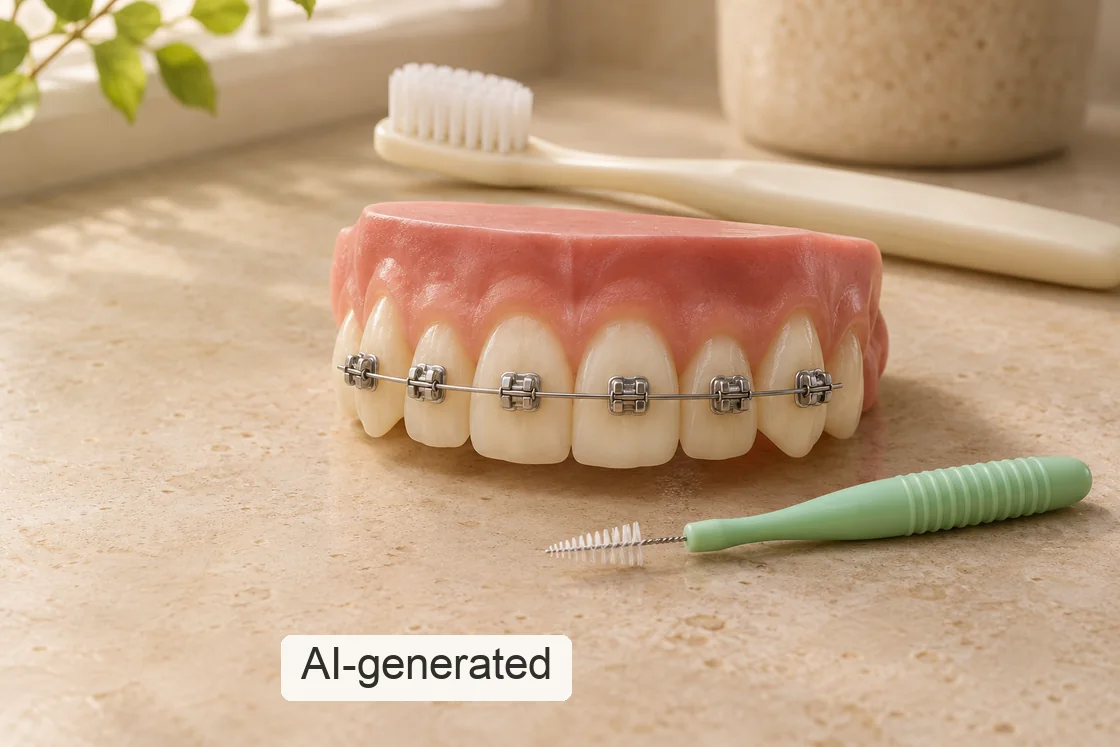
You can spot a piece of lettuce caught on a wire straight away. Soft plaque on the narrow strip of tooth between a bracket and the gum is harder to see. Brush that strip gently, then change the angle to reach the other side of the bracket. A small interdental brush helps you get under the wire. Here’s how to work your way around your teeth.
Published on
In this guide
Start at the gumline
Look at an upper front tooth in the mirror. Lift your upper lip a little with a clean finger. You can see a strip of exposed enamel between the bracket bonded to the tooth and the edge of the gum. It’s easy to miss that strip when you sweep the brush straight across the brace.
Angle the bristles where the tooth and gum meet. With a manual toothbrush, use small, gentle circles here. Work along one tooth at a time, right to the last molar. For your lower front teeth, ease your lower lip away so you can see where the teeth meet the gums.
Brush each bracket from two directions
First, tilt the brush head towards the bracket from the gum side. Change the angle so the bristles reach it from the biting or chewing edge of the tooth. As you switch direction, aim for the line where the edge of the bracket meets the tooth. Follow the same sequence along the row. Brush the inside and chewing surfaces of your teeth as well.
Brush at least twice a day with fluoride toothpaste, including before bed. Allow at least two minutes. If you’ve only reached the lower brackets when that time is up, give yourself time to finish the other surfaces. Spit out excess toothpaste. Skipping the water rinse afterwards leaves more fluoride on your teeth.
How do I reach under the wire?
Look at the wire between two brackets. Gently slide a small interdental brush into the space between the wire and the surface of the tooth. Clean along the side of one bracket, then along the side of the next. Leave the wire in place. This also helps you reach bits of food caught behind it after a meal.
The space between two teeth near the gum is often narrower. It may need a different brush size from the space under the wire. The brush should go in without force. Floss with a stiffened end is another option for tight spaces. The firm end lets you thread the floss beneath the wire, then clean between the teeth. Ask your dental team to show you which brush size or threading technique suits your teeth.
How can I spot an area I’ve missed?
To see where plaque remains after brushing, try a plaque-disclosing tablet according to the pack instructions. Look in the mirror, then focus on any coloured edges around individual brackets. If the same side of a canine repeatedly shows colour, try approaching it with the brush from the other angle. At your next visit you can ask for help with that exact spot.
When choosing a manual or electric brush, consider which helps you reach the tight spots. A one-year study of teenagers with fixed braces found no clear difference in plaque between the two brushes tested. If you’re unsure how to position yours, bring it to your next check-up.
If you notice a new chalky white patch on the tooth next to a bracket, ask a dentist to look at it. It can be a sign that the enamel has lost minerals. If your gum repeatedly bleeds in one spot, have that area checked as well.
Related reading
Sources and further information
- University Hospital Würzburg, Department of Orthodontics – brushing around fixed braces (German)
- Royal United Hospitals Bath – patient advice on cleaning braces and using fluoride toothpaste
- Dorset County Hospital – choosing and using interdental brushes
- Queensland Health – cleaning between teeth and threading floss under an orthodontic wire
- Johal and colleagues – one-year randomised study of manual and sonic toothbrushes in adolescents with fixed braces (2023)
- Ali and colleagues – randomised study of oral hygiene instruction and plaque disclosure in adults with braces (2026)