Who may find this relevant?
People with a reported lesion between teeth or questions about their individual decay risk.

Proximal caries is decay on the surface facing an adjacent tooth. These surfaces are often difficult to see directly. A lesion may therefore be present without pain or an obvious visible hole.
For training & practice ↓
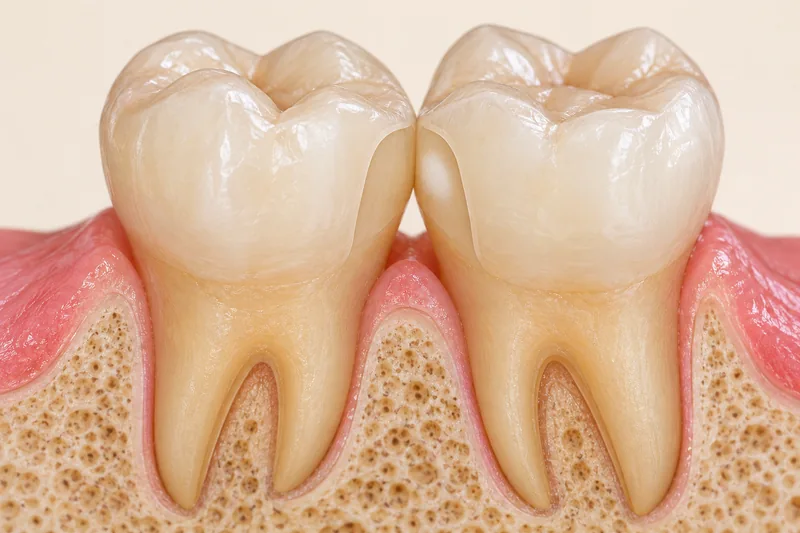
A side surface lies beneath or close to the contact point. Persistent plaque and repeated acid exposure can shift the balance towards mineral loss rather than repair.
Early mineral loss may occur while the surface remains intact. A deeper or cavitated lesion needs a different assessment; an image alone does not decide treatment.
Examination may be supplemented by a clinically justified bitewing radiograph. Surface integrity, activity and personal risk help guide preventive, minimally invasive or restorative care.
People with a reported lesion between teeth or questions about their individual decay risk.
By clinical examination and, when justified, additional imaging.
Fluoride toothpaste, suitable interdental cleaning, attention to sugar and tailored reviews.
Three steps. No audio.
Each scene can also be selected manually.

Silent educational film with German on-screen text and simplified teaching images. Not a patient case or a promised treatment outcome. The full English explanation is available below.
A side surface lies beneath or close to the contact point. Persistent plaque and repeated acid exposure can shift the balance towards mineral loss rather than repair.
Early mineral loss may occur while the surface remains intact. A deeper or cavitated lesion needs a different assessment; an image alone does not decide treatment.
Examination may be supplemented by a clinically justified bitewing radiograph. Surface integrity, activity and personal risk help guide preventive, minimally invasive or restorative care.
Proximal describes the location facing the next tooth. Secondary caries occurs beside an existing restoration. A lesion can fit both descriptions, but need not do so.
No. Early non-cavitated lesions may be managed without an operative restoration, and selected cases may suit a minimally invasive approach. A cavity or advanced damage may need a filling. The findings determine the choice.
No. Snagging or fraying can have several causes, including a rough restoration. Floss is a cleaning aid, not a reliable caries test.
No. The need and interval depend on findings, risk and existing images. A radiograph is not indicated merely because this glossary term was read.
An editorially suggested question for a discussion with Dr med dent Niusha Barahmand Pour:
Is the surface intact, how active does the lesion appear, and what does this mean for the next steps?
Has a change between your teeth been mentioned? Ask to see its location, activity and possible next steps in the context of your findings.
Discuss a caries findingAppointment selection at DoctolibProximal describes the location facing the next tooth. Secondary caries occurs beside an existing restoration. A lesion can fit both descriptions, but need not do so.
Editorial research: . General information, not an individual diagnosis or treatment recommendation. Teaching illustrations are simplified and do not depict a patient case.