Definite proof of a crack?
No. One test is insufficient.

A dental bite test checks whether controlled loading of a tooth or an individual cusp triggers symptoms. It can help narrow down the source of intermittent biting pain. A painful response alone does not prove a crack or determine treatment.
For training & practice ↓
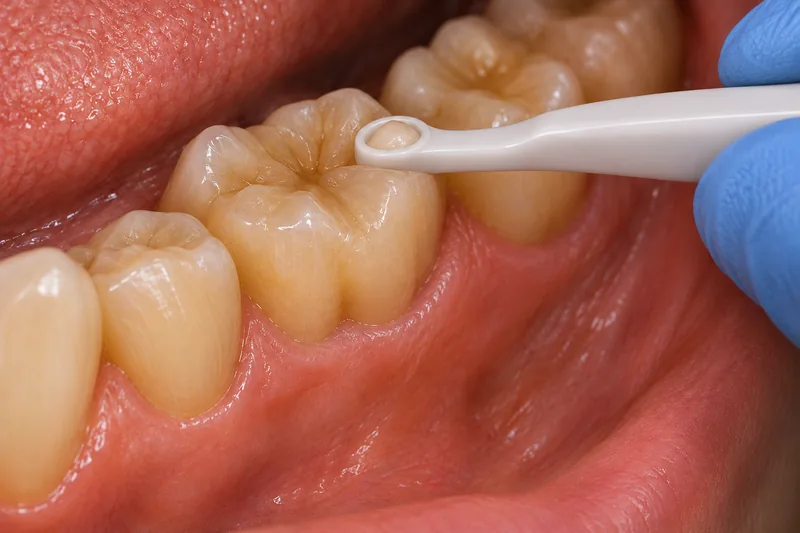
During examination, a tooth or an individual cusp may be loaded in a controlled way. This checks whether the reported symptoms can be reproduced at a specific site.
A cracked tooth may hurt when biting or as the load is released. Not every crack causes this pain, and not every biting pain means that a tooth is cracked.
The bite test is considered alongside the history, tooth examination and other appropriate tests. The full picture helps assess the cause, extent and possible treatment.
No. One test is insufficient.
That conclusion is not justified either.
No. Describe the symptoms and seek assessment.
Three steps. No audio.
Each scene can also be selected manually.

Silent educational film with German on-screen text and simplified teaching images. Not a patient case or a promised treatment outcome. The full English explanation is available as text.
A bite test assesses the response to mechanical loading. A cold test checks the response to a temperature stimulus and gives information about pulp nerve function. Both provide partial information and do not replace a complete examination.
No. It is a finding that needs to fit the symptoms and the rest of the examination. A bite test alone does not establish how far a possible crack extends or the condition of the pulp.
Parts of a cracked tooth may move slightly under load and irritate the tissue inside the tooth. Pain on release is possible but is not proof of a crack on its own.
Depending on the findings, pulp sensibility testing, examination around the gum margin, magnification, transillumination and justified radiographs may contribute. An early crack may not be visible on a radiograph.
No. Do not deliberately provoke pain by biting hard objects forcefully. Note when the pain occurs and have the tooth assessed instead. A painless self-test could also create false reassurance.
You can bring this question to your appointment:
Does the pain occur when biting, releasing the bite or also in response to cold?
Recurring biting pain can be assessed in a dental examination.
Arrange an assessmentAppointment selection at DoctolibA bite test assesses the response to mechanical loading. A cold test checks the response to a temperature stimulus and gives information about pulp nerve function. Both provide partial information and do not replace a complete examination.
Editorial research: . General information, not an individual diagnosis or treatment recommendation. Teaching illustrations are simplified and do not depict a patient case.