Is RT a length?
No; it is a recession type.

The Cairo classification groups gingival recessions by loss of tissue attachment between the teeth and on the outer surface of the affected tooth. The types are RT1, RT2 and RT3. They do not simply state how many millimetres of root are visible.
For training & practice ↓
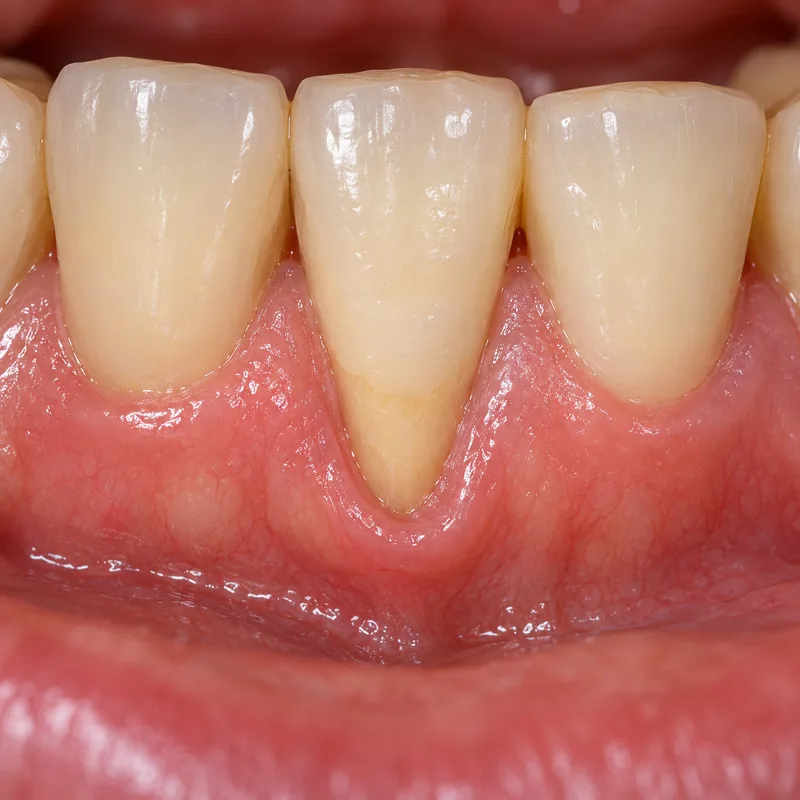
RT1 has no loss of attachment between the teeth. The outer root may still be exposed. Visible recession and tissue attachment are different measurements.
RT2 includes attachment loss between teeth that is no greater than attachment loss on the outer tooth surface. The comparison matters, not just the visible length.
In RT3, interproximal attachment loss exceeds the outer-surface loss. This informs assessment of possible root coverage. A category alone neither guarantees nor rules out a specific treatment.
No; it is a recession type.
Yes.
No; the type is one factor.
Three steps. No audio.
Each scene can also be selected manually.

Silent educational film with German on-screen text and simplified teaching images. Not a patient case or a promised treatment outcome. The full English explanation is available as text.
Recession depth is the distance from the cemento-enamel junction to the gingival margin. Cairo type compares attachment loss on different tooth surfaces.
No. The number identifies a category, not a length.
Not reliably. Clinical attachment measurements at several sites are needed.
No. The category supports prognosis but does not account for every factor affecting treatment.
You can bring this question to your appointment:
Which recession type is present, and what other factors limit achievable root coverage?
Discuss your individual findings and whether a referral is appropriate.
Discuss your findingsAppointment selection at DoctolibRecession depth is the distance from the cemento-enamel junction to the gingival margin. Cairo type compares attachment loss on different tooth surfaces.
Editorial research: . General information, not an individual diagnosis or treatment recommendation. Teaching illustrations are simplified and do not depict a patient case.