Is a high canine the same as an unerupted impacted canine?
Part of a high canine may already be visible. A tooth still within the jaw cannot be seen directly in the mouth. The assessment describes which part has erupted and where space is lacking.

A high-positioned canine has a crown that sits well above the crowns of neighbouring teeth. An upper canine may erupt towards the lip outside a crowded dental arch. Seeing its cusp does not reveal where the root lies.
For training & practice ↓
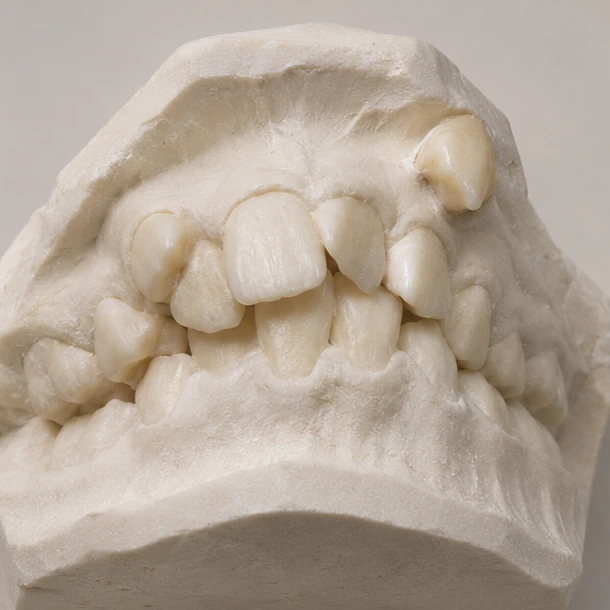
The upper canine on this model sits towards the lip and above the neighbouring crowns.
The isolated canine shows its long root, which is hidden in the mouth.
This lower arch illustrates crowding for comparison. The available space for an upper canine is assessed in the upper arch.
The upper canine on this model sits towards the lip and above the neighbouring crowns.
The isolated canine shows its long root, which is hidden in the mouth.
This lower arch illustrates crowding for comparison. The available space for an upper canine is assessed in the upper arch.
Part of a high canine may already be visible. A tooth still within the jaw cannot be seen directly in the mouth. The assessment describes which part has erupted and where space is lacking.
An orthodontist assesses the arch, available space, neighbouring teeth and bite. Depending on the question, X-rays may clarify the position relative to adjacent roots.
Exposure creates access to a covered tooth. An erupted canine raises different questions, including the space required to align it. Options depend on the findings.
Three steps. No audio.
Each scene can also be selected manually.

Silent film with English on-screen text and simplified teaching images.
A high position describes location. Unerupted means the crown has yet to emerge through the gum.
Part of a high canine may already be visible. A tooth still within the jaw cannot be seen directly in the mouth. The assessment describes which part has erupted and where space is lacking.
An orthodontist assesses the arch, available space, neighbouring teeth and bite. Depending on the question, X-rays may clarify the position relative to adjacent roots.
Exposure creates access to a covered tooth. An erupted canine raises different questions, including the space required to align it. Options depend on the findings.
A question to ask
Has the canine already erupted, and where is there too little space for alignment?
An unusual eruption pattern or a marked difference between sides merits assessment.
Choose an appointmentAppointment selection at DoctolibRecord crown height, eruption status, cheek-side or palate-side position and proximity to neighbouring roots separately.
Editorial research: . General information, not an individual diagnosis or treatment recommendation. Teaching illustrations are simplified and do not depict a patient case.
If you turn this on, this website stores which guides you open, separately from advertising preferences. The markers expire after a fixed 30-day period from activation. The list is not sent to us by this feature. You can turn it off here and delete the markers.
Other people using the same browser profile can also see the markers. German and English versions share one marker. Expired entries are removed the next time you open a page with this feature; deleting browser data may remove them earlier. “Viewed” means opened, not read or completed.