What does EDTA bind?
Calcium ions.

EDTA is a chelating agent: it binds calcium ions. During root canal treatment, one of its roles is to help remove the mineral component of the smear layer created when dentine is instrumented. It complements other irrigants rather than replacing all of their functions.
For training & practice ↓
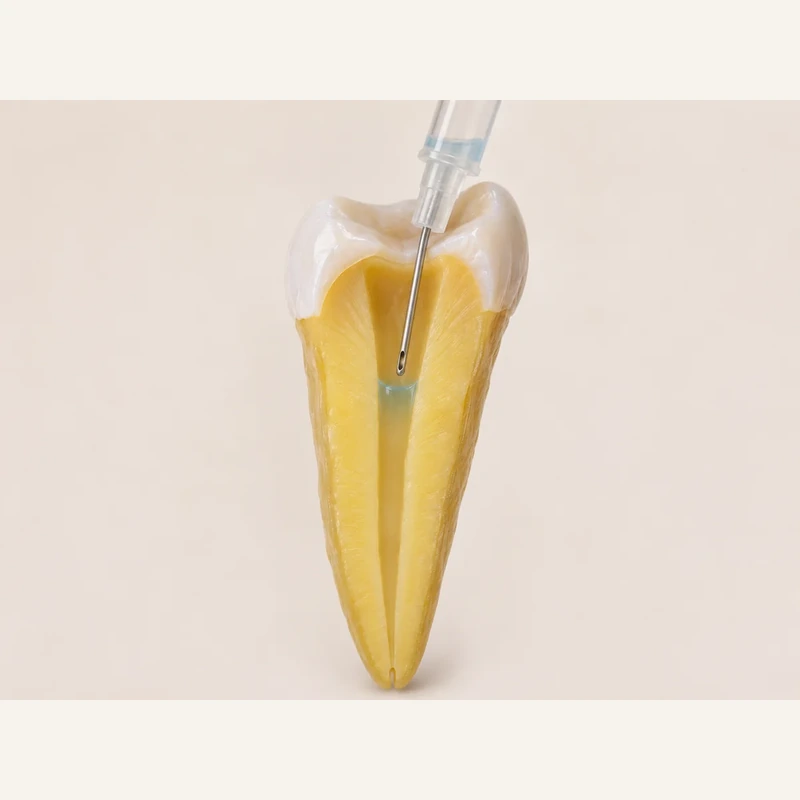
Canal preparation leaves a fine mixture of debris on the walls. Its mineral component is one target for EDTA.
Binding calcium helps remove mineral residues. This does not make EDTA equivalent to sodium hypochlorite’s ability to dissolve organic tissue.
Contact time and sequence are selected professionally. Excessive or unsuitable use can alter dentine; uncontrolled mixing can reduce the activity of other solutions.
Calcium ions.
To address the mineral component of the smear layer.
No. Interactions and sequence matter.
Three steps. No audio.
Each scene can also be selected manually.

Silent educational film with German on-screen text and simplified teaching images. Not a patient case or a promised treatment outcome. The full English explanation is available as text.
EDTA acts on mineral components by binding calcium. Sodium hypochlorite is antimicrobial and dissolves organic tissue. Different roles do not mean they can be mixed arbitrarily.
It is primarily used for its chelating action. Complete treatment involves coordinated cleaning and disinfection; EDTA alone does not guarantee sterility.
No. EDTA supports preparation or irrigation. A sealer is a material used to help seal the root filling.
The approach depends on the clinical situation, materials and treatment concept. It is applied by the treating team and is not a self-use procedure.
You can bring this question to your appointment:
What roles do the different irrigants have in my treatment?
An individual examination can clarify the findings and suitable next steps.
Arrange an assessmentAppointment selection at DoctolibEDTA acts on mineral components by binding calcium. Sodium hypochlorite is antimicrobial and dissolves organic tissue. Different roles do not mean they can be mixed arbitrarily.
Editorial research: . General information, not an individual diagnosis or treatment recommendation. Teaching illustrations are simplified and do not depict a patient case.
If you turn this on, this website stores which guides you open, separately from advertising preferences. The markers expire after a fixed 30-day period from activation. The list is not sent to us by this feature. You can turn it off here and delete the markers.
Other people using the same browser profile can also see the markers. German and English versions share one marker. Expired entries are removed the next time you open a page with this feature; deleting browser data may remove them earlier. “Viewed” means opened, not read or completed.