What is it for?
Disinfection and dissolution of organic remnants in the canal.

Sodium hypochlorite, abbreviated NaOCl, is used as a professional root canal irrigant. It acts against microorganisms and can dissolve organic tissue. This action requires controlled use in an isolated tooth: the solution can injure tissue outside the intended treatment area.
For training & practice ↓
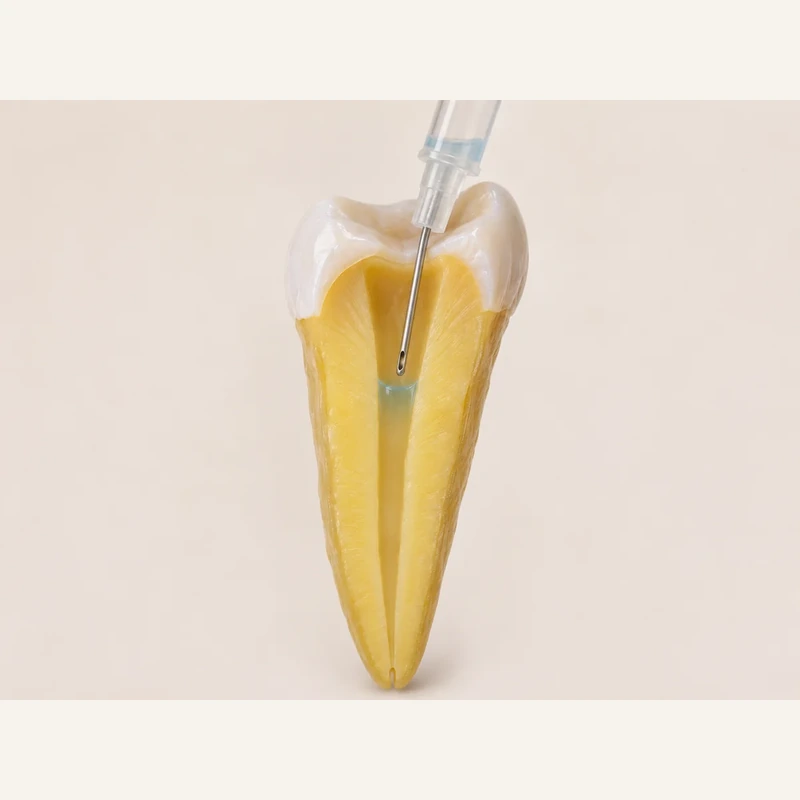
Files do not reach every surface of a branching canal system. Irrigation supplements mechanical cleaning without guaranteeing complete sterility.
Concentration, contact time and safe delivery are tailored to treatment. More solution or greater strength is not automatically better.
A dental dam protects the rest of the mouth. Extrusion beyond the root tip must also be avoided. Unusually severe pain or rapid swelling needs immediate assessment.
Disinfection and dissolution of organic remnants in the canal.
No. It requires controlled professional use.
Tooth isolation and safe irrigation technique.
Three steps. No audio.
Each scene can also be selected manually.

Silent educational film with German on-screen text and simplified teaching images. Not a patient case or a promised treatment outcome. The full English explanation is available as text.
Despite the similar beginning of their names, they are different substances. NaOCl is used here for professional canal irrigation. Sodium fluoride is used, among other purposes, to help prevent caries.
No. Endodontic sodium hypochlorite solution is not for self-directed oral care. Household products must not be used for this purpose.
No. It is a locally applied chemical irrigant. Whether a systemic medicine is needed is a separate clinical question.
EDTA mainly acts on the mineral part of the smear layer. The agents serve different purposes; their combination and sequence require professional control.
You can bring this question to your appointment:
Which protective measures and irrigants suit the anatomy of my tooth?
An individual examination can clarify the findings and suitable next steps.
Arrange an assessmentAppointment selection at DoctolibDespite the similar beginning of their names, they are different substances. NaOCl is used here for professional canal irrigation. Sodium fluoride is used, among other purposes, to help prevent caries.
Editorial research: . General information, not an individual diagnosis or treatment recommendation. Teaching illustrations are simplified and do not depict a patient case.
If you turn this on, this website stores which guides you open, separately from advertising preferences. The markers expire after a fixed 30-day period from activation. The list is not sent to us by this feature. You can turn it off here and delete the markers.
Other people using the same browser profile can also see the markers. German and English versions share one marker. Expired entries are removed the next time you open a page with this feature; deleting browser data may remove them earlier. “Viewed” means opened, not read or completed.