How is it constructed?
A pontic with its supporting connection on one side only.

A cantilever bridge is a fixed bridge whose replacement tooth is supported by one or more abutments on only one side. There is no abutment on the other side of the pontic. Distribution of chewing forces is therefore important in planning.
For training & practice ↓
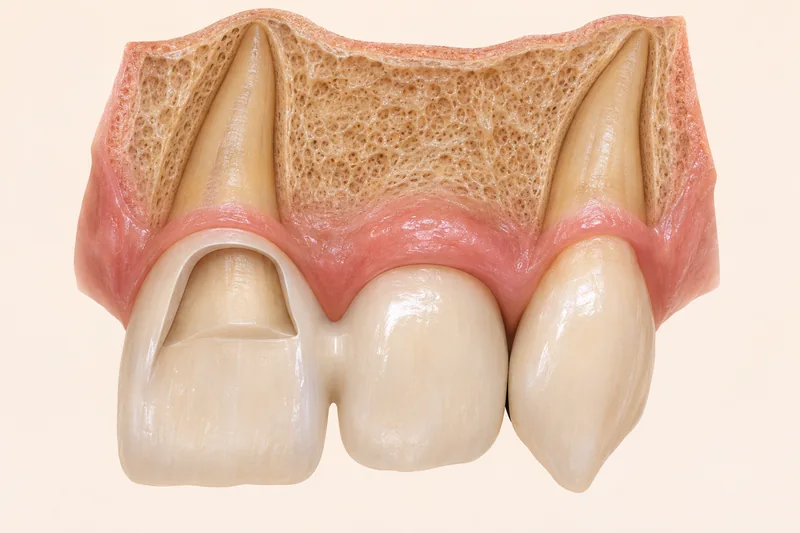
The artificial bridge tooth is retained from one side. It does not sit between two terminal abutments like a conventional end-supported bridge.
Distance from the abutment, bite and the condition of supporting structures influence loading. A cantilever design cannot simply be extended without limits.
Assessment and planning determine suitability. The restoration requires cleaning around the abutment and beneath the pontic, with regular review.
A pontic with its supporting connection on one side only.
The gap, supporting structures, bite and proposed design.
Cleaning around the abutment and underneath the pontic with suitable aids.
Three steps. No audio.
Each scene can also be selected manually.

Silent educational film with German on-screen text and simplified teaching images. Not a patient case or a promised treatment outcome. The full English explanation is available as text.
A cantilever bridge is fixed. A distal-extension denture is removable and replaces teeth beyond the remaining natural teeth; its support is planned differently.
No. Cantilever describes one-sided support, not the attachment method. A resin-bonded bridge is a particular design and may itself use one-sided attachment.
No. The location and size of the gap, abutments and bite limit suitability. A diagram cannot determine whether it is right for an individual.
As well as accessible tooth surfaces, the area beneath the pontic needs cleaning. Suitable cleaning aids should be demonstrated for the actual restoration.
You can bring this question to your appointment:
How will the abutments be loaded, and which design suits this gap?
Discuss which replacement options may suit your gap and dental situation.
Discuss a missing toothAppointment selection at DoctolibA cantilever bridge is fixed. A distal-extension denture is removable and replaces teeth beyond the remaining natural teeth; its support is planned differently.
Editorial research: . General information, not an individual diagnosis or treatment recommendation. Teaching illustrations are simplified and do not depict a patient case.