What affects its extent?
The position of the gaps and the supporting areas available.

A palatal plate is a broad connector in an upper partial denture. It joins the denture components on both sides. A broad plate can also spread some chewing load across the tissue covering the palate.
For training & practice ↓
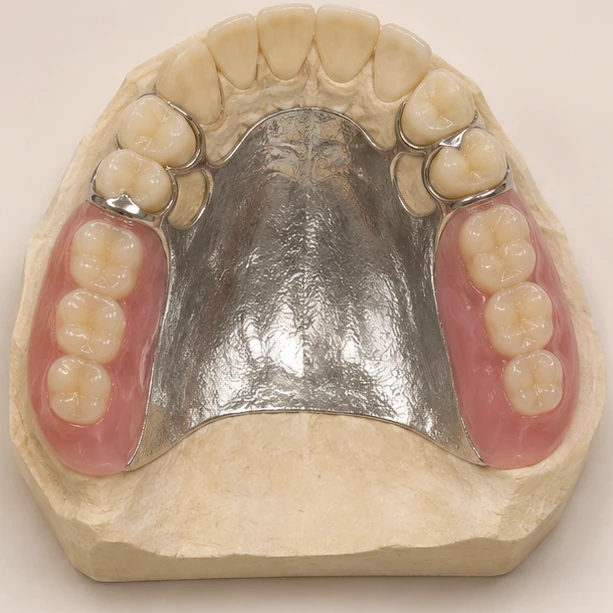
The plate crosses from one side of the hard palate to the other. Its extent depends in part on which teeth are missing and where support is available.
Remaining teeth may support the denture. Replacement teeth sit in the saddles. The plate connects these areas into a stable unit.
Removing the denture exposes the underside of the plate and the tissue beneath it. Ask the clinician to point out areas needing particular attention on your own denture.
The position of the gaps and the supporting areas available.
A word in which your tongue repeatedly catches on a particular area.
When wearing the denture causes recurring soreness or pain.
Three steps. No audio.
Each scene can also be selected manually.

Silent film with English on-screen text and simplified teaching images.
A partial denture can have a broad plate while natural teeth remain. Palatal coverage alone does not identify the type of denture.
When many teeth are missing or only a few can support a denture, broader coverage may help. Other arrangements allow narrower connectors. The design has to work as a whole.
The tongue meets a new surface when speaking. Its thickness, position and contours may be noticeable. At review, use a particular word to demonstrate the sound you find difficult.
Removing an area can change stiffness and load distribution. Gagging, pressure or a sore patch warrants a check of the border and the overall fit first.
A question to bring along
What role does this area play given the position of my remaining teeth?
Bring the upper denture and show the clinician exactly where it bothers you.
Choose a dental appointmentAppointment selection at DoctolibComfort and mechanical requirements are assessed together when deciding how much palate to cover.
Editorial research: . General information, not an individual diagnosis or treatment recommendation. Teaching illustrations are simplified and do not depict a patient case.
If you turn this on, this website stores which guides you open, separately from advertising preferences. The markers expire after a fixed 30-day period from activation. The list is not sent to us by this feature. You can turn it off here and delete the markers.
Other people using the same browser profile can also see the markers. German and English versions share one marker. Expired entries are removed the next time you open a page with this feature; deleting browser data may remove them earlier. “Viewed” means opened, not read or completed.