Are there real hairs?
No. The name describes the surface.

Oral hairy leukoplakia is a mucosal change associated with Epstein–Barr virus. It typically produces whitish, folded or streaked areas along the sides of the tongue that do not simply wipe away. It is more common with weakened immunity, but does not prove a particular underlying disease. Confirmed oral hairy leukoplakia is not considered precancerous.
For training & practice ↓
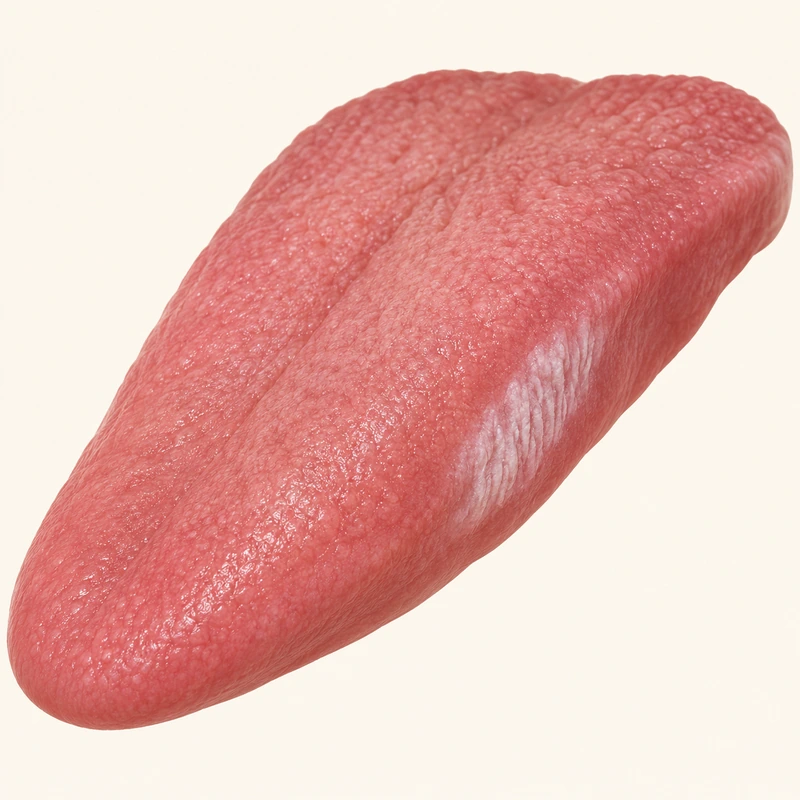
Changes often affect one or both sides of the tongue. Folds or white streaks explain the name; no actual hairs grow there. A photograph alone cannot confirm the diagnosis.
Epstein–Barr virus is involved. Medicines and illnesses affecting immunity are relevant to the history. Rare cases also occur without known immune suppression.
Other white tongue lesions need to be distinguished. Tissue and viral studies can confirm the diagnosis. Care also considers any underlying medical condition.
No. The name describes the surface.
The lateral tongue.
Confirmed oral hairy leukoplakia is not considered precancerous.
Three steps. No audio.
Each scene can also be selected manually.

Silent educational film with German on-screen text and simplified teaching images. Not a patient case or a promised treatment outcome. The full English explanation is available as text.
The similar names can mislead. Hairy leukoplakia is a defined EBV-associated condition. Other white lesions described as leukoplakia may have a different risk profile and require their own assessment.
No. It can occur with different causes of immune suppression and rarely without known immune impairment. Appropriate tests are discussed confidentially in light of history and examination.
No. Hairy tongue involves elongated filiform papillae on the upper tongue surface. Oral hairy leukoplakia is a different EBV-associated mucosal condition, commonly on the lateral tongue.
No. It is often symptom-free and is not considered precancerous. Confirming the diagnosis and assessing immune status matter; local treatment is not always needed.
No. This is not an ordinary coating. Scraping hard may injure tissue and does not establish the cause.
You can bring this question to your appointment:
How will the diagnosis be confirmed, and should my immune status be investigated?
An individual examination can clarify the findings and suitable next steps.
Arrange an assessmentAppointment selection at DoctolibThe similar names can mislead. Hairy leukoplakia is a defined EBV-associated condition. Other white lesions described as leukoplakia may have a different risk profile and require their own assessment.
Editorial research: . General information, not an individual diagnosis or treatment recommendation. Teaching illustrations are simplified and do not depict a patient case.
If you turn this on, this website stores which guides you open, separately from advertising preferences. The markers expire after a fixed 30-day period from activation. The list is not sent to us by this feature. You can turn it off here and delete the markers.
Other people using the same browser profile can also see the markers. German and English versions share one marker. Expired entries are removed the next time you open a page with this feature; deleting browser data may remove them earlier. “Viewed” means opened, not read or completed.