What might stay?
A supported root together with its part of the crown.

In hemisection, a multi-rooted molar is divided through its crown to where its roots separate. If one half cannot be saved, it can be removed with its root while the other half is restored.
For training & practice ↓
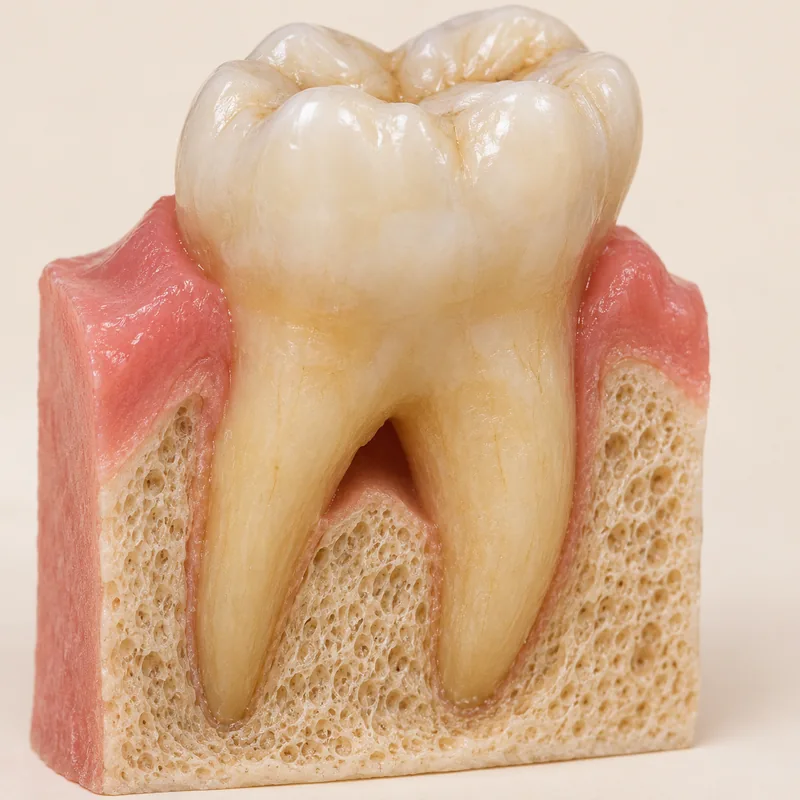
Most lower molars have two roots beneath the crown. The furcation is the point where the roots separate.
The division goes through the chewing surface to the furcation. Each half therefore includes part of the crown and its corresponding root.
The remaining part needs bone support, a root that can be managed and a suitable new biting surface. Daily cleaning matters when choosing its shape.
A supported root together with its part of the crown.
The crown through to the space between the roots.
The new contour changes loading and cleaning.
Three steps. No audio.
Each scene can also be selected manually.

Silent film with English on-screen text and simplified teaching images.
Root amputation removes a root without necessarily removing the part of the crown above it.
If damage is confined to one root, the unaffected portion may be worth retaining. Extensive damage or poor bone support can make this option unsuitable.
In selected cases both separated parts can be retained and restored individually. This is also called bicuspidisation or premolarisation.
Margins need to remain accessible. Reviews assess the gum, root and restoration. Long-term study results do not predict how an individual tooth will fare.
A question to bring along
How would the remaining half be restored and how would I clean around it?
Discuss the prospects for the remaining tooth and the alternatives using your dental images.
Choose an appointmentAppointment selection at DoctolibExtraction removes the whole tooth. Hemisection involves assessing whether a specific portion can be retained.
Editorial research: . General information, not an individual diagnosis or treatment recommendation. Teaching illustrations are simplified and do not depict a patient case.
If you turn this on, this website stores which guides you open, separately from advertising preferences. The markers expire after a fixed 30-day period from activation. The list is not sent to us by this feature. You can turn it off here and delete the markers.
Other people using the same browser profile can also see the markers. German and English versions share one marker. Expired entries are removed the next time you open a page with this feature; deleting browser data may remove them earlier. “Viewed” means opened, not read or completed.