What is assessed?
Surface integrity, extent and activity.

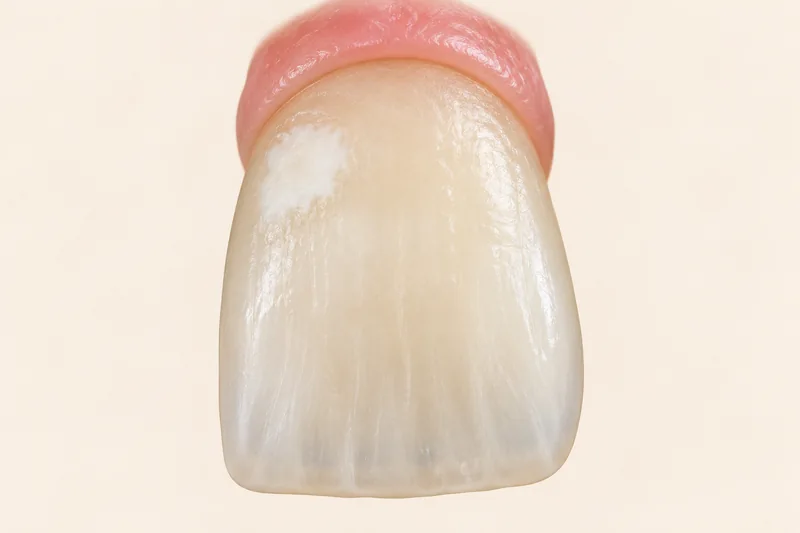
Initial caries is an early stage of decay-related mineral loss. The surface may still be intact. Under suitable conditions such lesions can be stabilised; toothpaste cannot rebuild an already collapsed cavity.
For training & practice ↓
Plaque bacteria use sugar to produce acids. Repeated acid exposure can shift the balance between mineral loss and repair.
A chalky pale area may be a clue but does not automatically mean decay. Surface, site, visibility and relevant radiographs are assessed together.
Fluoride, tailored cleaning and less frequent sugar exposure can support control. Other measures and review intervals depend on lesion location and activity.
Surface integrity, extent and activity.
Individual prevention including fluoride and plaque control.
To assess stability or progression.
Three steps. No audio.
Each scene can also be selected manually.

Silent educational film with German on-screen text and simplified teaching images. Not a patient case or a promised treatment outcome. The full English explanation is available below.
Plaque bacteria use sugar to produce acids. Repeated acid exposure can shift the balance between mineral loss and repair.
A chalky pale area may be a clue but does not automatically mean decay. Surface, site, visibility and relevant radiographs are assessed together.
Fluoride, tailored cleaning and less frequent sugar exposure can support control. Other measures and review intervals depend on lesion location and activity.
A white spot describes an appearance. Early decay is one possible cause; developmental enamel changes can also appear pale.
Not necessarily. A stabilised lesion can remain visible. Disease control and appearance are different questions.
No. Non-invasive management may be appropriate for an early lesion with an intact surface. Examination determines this.
Not reliably. Colour or a photograph alone is insufficient.
Editorially suggested question to discuss with Dr Niusha Barahmand Pour:
Is the surface still intact, and how will its progress be monitored?
A newly noticed mark is worth checking early.
Have a tooth mark assessedAppointment selection at DoctolibA white spot describes an appearance. Early decay is one possible cause; developmental enamel changes can also appear pale.
Editorial research: . General information, not an individual diagnosis or treatment recommendation. Teaching illustrations are simplified and do not depict a patient case.