Always decay?
No; the term initially describes a defect.

A dental cavity is an area of missing tooth tissue or a space prepared to receive a restoration. Decay can cause it, but so can other forms of tissue loss. The term describes the defect and its shape rather than establishing its cause or activity. Planning considers its location and extent, the remaining tooth structure and the condition of the pulp.
For training & practice ↓
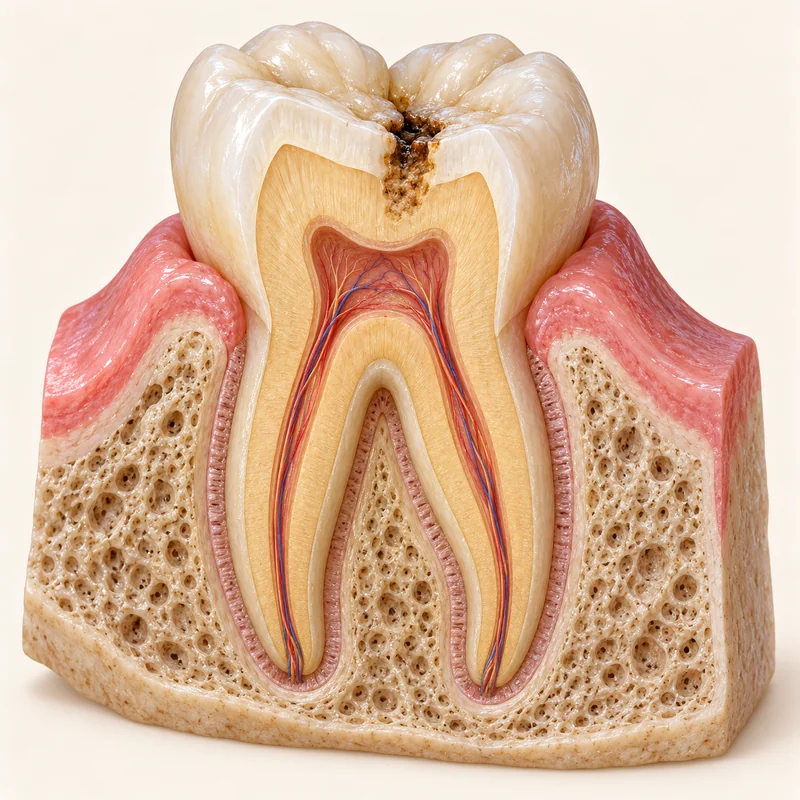
A cavity is missing tooth structure or a prepared restorative space. The word alone does not establish what caused the defect.
A defect may involve the chewing surface, a side surface or several surfaces. Its proximity to the pulp is separate from the size of its visible opening.
Before restoration, the cause, extent and remaining tooth tissue are assessed. If decay is involved, controlling the disease process also matters.
No; the term initially describes a defect.
No; surface extent and depth are separate.
Preserving tissue and restoring the tooth according to findings.
Three steps. No audio.
Each scene can also be selected manually.

Silent educational film with German on-screen text and simplified teaching images. Not a patient case or a promised treatment outcome. The full English explanation is available as text.
Cavity describes a tissue defect or prepared space. Caries is a disease process; the terms are not interchangeable.
No. Erosion, abrasion and a prepared restorative space can also be described as a cavity. Diagnosing caries requires further findings.
Not necessarily. Colour alone does not establish tissue loss. Examination clarifies whether there is a defect and what caused it.
The defect involves more than one tooth surface, such as the chewing and neighbouring-tooth surfaces. Surface count alone does not establish depth.
No. The cavity is the existing or prepared space. A filling or a suitable inlay can restore that space.
No. Carious tissue removal depends on the findings. Selective removal may be appropriate in suitable vital teeth; colour alone is not a complete treatment plan.
You can bring this question to your appointment:
What caused the cavity, and how much healthy tooth structure can be preserved?
A dental examination can clarify how this relates to your findings and treatment planning.
Discuss your dental findingsAppointment selection at DoctolibCavity describes a tissue defect or prepared space. Caries is a disease process; the terms are not interchangeable.
Editorial research: . General information, not an individual diagnosis or treatment recommendation. Teaching illustrations are simplified and do not depict a patient case.
If you turn this on, this website stores which guides you open, separately from advertising preferences. The markers expire after a fixed 30-day period from activation. The list is not sent to us by this feature. You can turn it off here and delete the markers.
Other people using the same browser profile can also see the markers. German and English versions share one marker. Expired entries are removed the next time you open a page with this feature; deleting browser data may remove them earlier. “Viewed” means opened, not read or completed.