What does orthodontics assess?
Tooth alignment and the relationship between the arches.

Orthodontics looks at where teeth sit within the dental arches and how the upper and lower teeth meet. A rotated tooth, crowding within an arch and a discrepancy between the two jaws are distinct findings and may call for different treatment goals.
For training & practice ↓
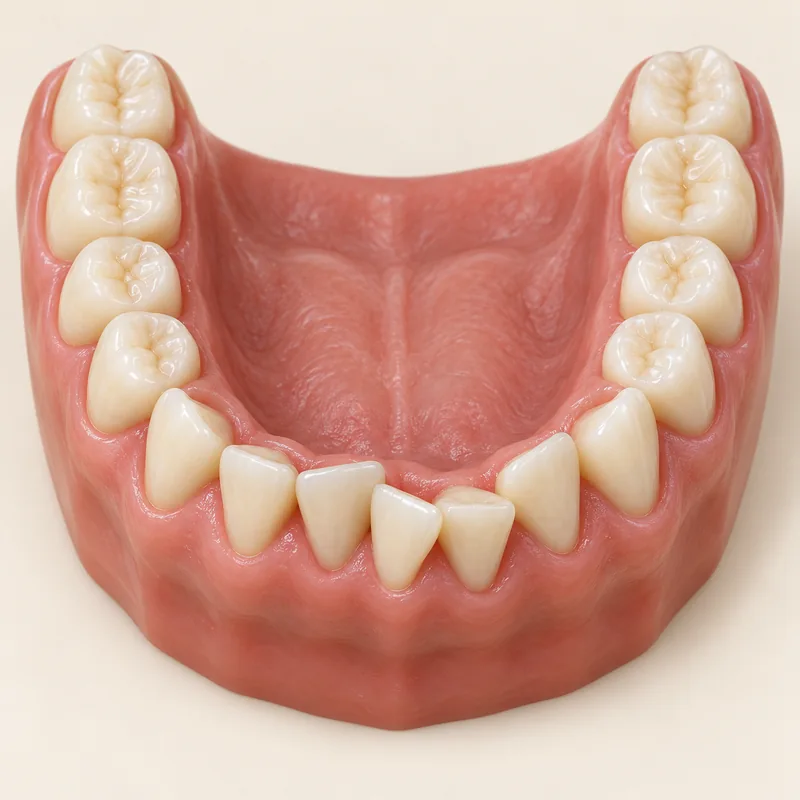
When teeth are rotated or displaced, the clinician assesses the space available in the whole arch.
A bite model shows which teeth meet on closure, adding information to the view of one arch.
The planned movement helps determine the appliance. The plate shown is one of several options.
When teeth are rotated or displaced, the clinician assesses the space available in the whole arch.
A bite model shows which teeth meet on closure, adding information to the view of one arch.
The planned movement helps determine the appliance. The plate shown is one of several options.
Tooth alignment and the relationship between the arches.
Several teeth compete for space in the same arch.
A retainer may be needed to maintain the result.
Three steps. No audio.
Each scene can also be selected manually.

Silent film with English on-screen text and simplified teaching images.
You can see a rotated tooth within one arch. To assess the bite, you need to look at how both arches meet.
The clinician examines the teeth and bite and asks about chewing, cleaning and your concerns. Depending on the question, photographs, models, a scan or selected X-rays may help. Mention previous dental injuries and bring available records.
The extent of the finding, its effect on function and your preferences all matter. Ask what treatment could improve in your particular case and what to expect if you wait.
Yes. Planning takes account of the movement required and the health of the teeth and their supporting tissues. Keeping teeth in position after active treatment is part of the plan.
A question to ask
Which part of my finding concerns tooth alignment, and which part concerns the bite?
You can discuss your bite at a dental examination.
Choose an appointmentAppointment selection at DoctolibCrowding describes the space available in one arch. A bite discrepancy describes how the two arches meet. A person can have both.
Editorial research: . General information, not an individual diagnosis or treatment recommendation. Teaching illustrations are simplified and do not depict a patient case.
If you turn this on, this website stores which guides you open, separately from advertising preferences. The markers expire after a fixed 30-day period from activation. The list is not sent to us by this feature. You can turn it off here and delete the markers.
Other people using the same browser profile can also see the markers. German and English versions share one marker. Expired entries are removed the next time you open a page with this feature; deleting browser data may remove them earlier. “Viewed” means opened, not read or completed.