A separate inlay
The bonding surface lies on the inside of the inlay and meets the tooth preparation.

Conditioning prepares the inner surface to bond to a luting material. The dental team selects a surface treatment and primer appropriate to the ceramic. The prepared surface can then interact with the adhesive cement.
For training & practice ↓
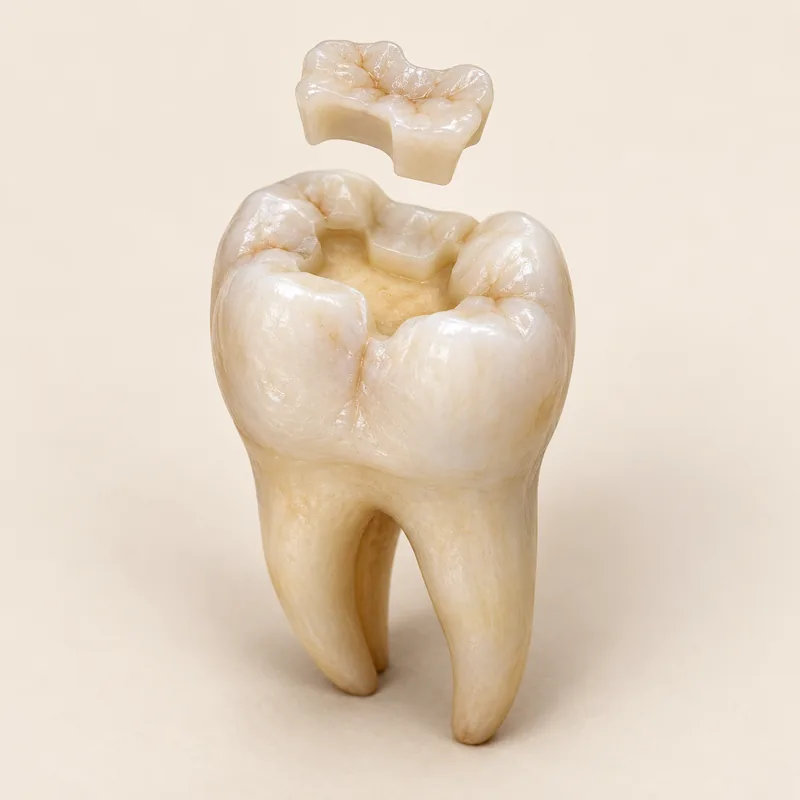
The bonding surface lies on the inside of the inlay and meets the tooth preparation.
Tooth colour does not identify the ceramic family. The material helps determine suitable pretreatment.
The luting material joins the prepared ceramic and tooth surfaces.
The bonding surface lies on the inside of the inlay and meets the tooth preparation.
Tooth colour does not identify the ceramic family. The material helps determine suitable pretreatment.
The luting material joins the prepared ceramic and tooth surfaces.
The bonding surface lies on the inside of the inlay and meets the tooth preparation.
Tooth colour does not identify the ceramic family. The material helps determine suitable pretreatment.
The luting material joins the prepared ceramic and tooth surfaces.
Three steps. No audio.
Each scene can also be selected manually.

Silent film with English on-screen text and simplified teaching images.
A glass-containing ceramic such as lithium disilicate and a predominantly crystalline oxide ceramic such as zirconia respond differently. The actual material and the matching bonding system guide the choice.
A glass-containing ceramic such as lithium disilicate and a predominantly crystalline oxide ceramic such as zirconia respond differently. The actual material and the matching bonding system guide the choice.
The inner face forms the bonding surface. The polished or glazed outside has a different purpose and is finished differently.
Appearance alone cannot identify the cause. Bring the detached piece to your dentist. The restoration, tooth and fit must be assessed before rebonding is considered.
A question to ask
Which ceramic is my restoration made from and how will it be bonded?
Choose an appointment to discuss your own tooth or restoration.
Choose an appointmentAppointment selection at DoctolibTreat preparation of the ceramic and preparation of enamel or dentin as separate parts of the bonding procedure. The material family matters more than the shade when choosing a protocol.
Editorial research: . General information, not an individual diagnosis or treatment recommendation. Teaching illustrations are simplified and do not depict a patient case.
If you turn this on, this website stores which guides you open, separately from advertising preferences. The markers expire after a fixed 30-day period from activation. The list is not sent to us by this feature. You can turn it off here and delete the markers.
Other people using the same browser profile can also see the markers. German and English versions share one marker. Expired entries are removed the next time you open a page with this feature; deleting browser data may remove them earlier. “Viewed” means opened, not read or completed.