Who might it be relevant for?
Selected cases with limited bone height.

Short implants may be an option when bone height is limited, particularly in the back of the jaw. Definitions vary; the ITI consensus used here compares implants six millimetres long or shorter with longer implants. Length alone does not make an implant suitable or unsuitable. Bone, loading and the planned restoration must be assessed together.
For training & practice ↓
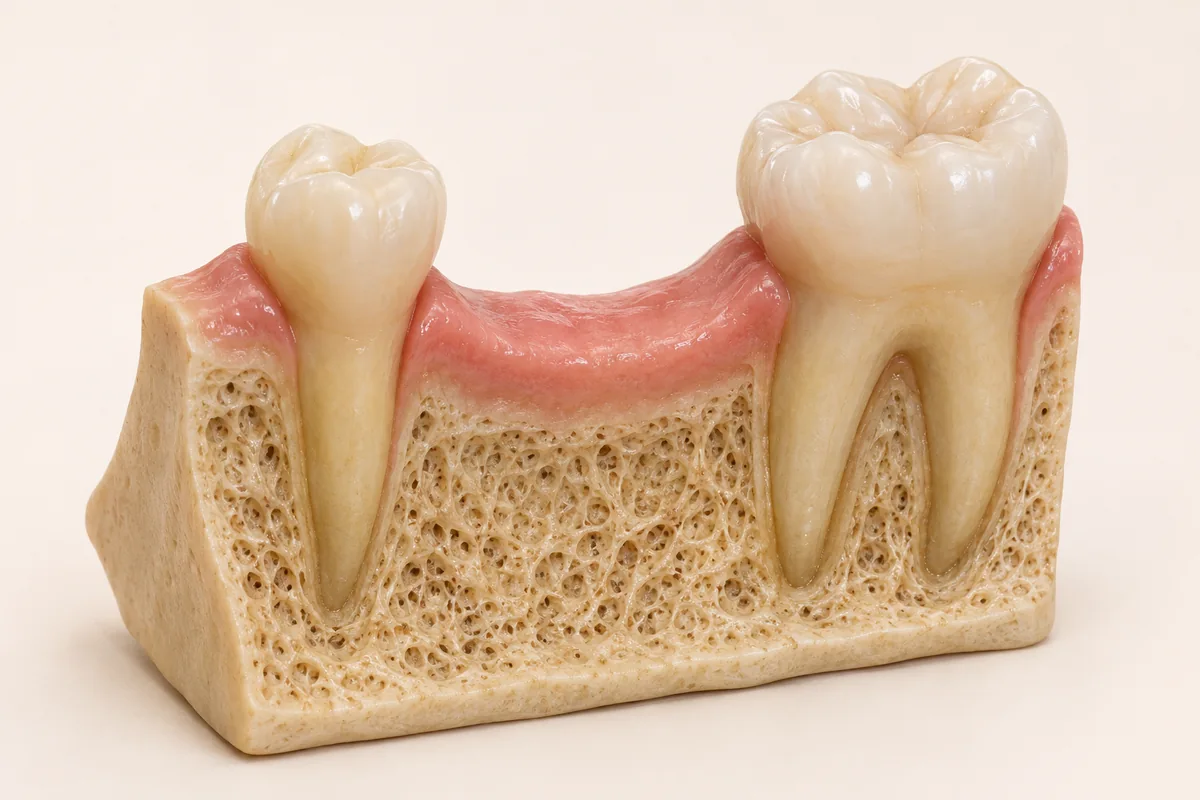
Planning considers the bone and neighbouring structures such as the mandibular canal or maxillary sinus. A suitable implant length cannot be determined from an ordinary photograph.
Diameter, position, bone quality and loading also matter. In selected situations, short implants may reduce the extent of additional bone augmentation.
The future crown or bridge, cleaning and reviews belong in the decision. Study findings do not guarantee an individual outcome; longer-term results require particular care in interpretation.
Selected cases with limited bone height.
No. The overall findings and future restoration determine the treatment involved.
Safe positioning, alternatives and limitations of the available long-term evidence.
Three steps. No audio.
Each scene can also be selected manually.

Silent educational film with German on-screen text and simplified teaching images. Not a patient case or a promised treatment outcome. The full English explanation is available as text.
Length runs along the implant into the bone; diameter runs across it. A short implant need not be narrow, and a narrow implant need not be short.
No. A short implant may be an alternative to more extensive augmentation in suitable cases. There must still be enough bone for safe positioning.
The 2018 ITI consensus describes comparable survival in selected studies over one to five years but notes uncertainty with longer time in function. This is not a guarantee of equivalence for every restoration.
No. Short refers to length; a mini implant usually refers to a particularly small diameter. These features should not be confused.
You can bring this question to your appointment:
Would a short implant be suitable in my case, and what are its advantages and disadvantages compared with bone augmentation?
If bone height is limited, you can discuss suitable restoration options and their individual limitations.
Discuss your findingsAppointment selection at DoctolibLength runs along the implant into the bone; diameter runs across it. A short implant need not be narrow, and a narrow implant need not be short.
Editorial research: . General information, not an individual diagnosis or treatment recommendation. Teaching illustrations are simplified and do not depict a patient case.