What remains central?
Mechanical deposit removal and ongoing maintenance.

Lasers in periodontal therapy refers to different uses of concentrated light on the tooth-supporting tissues. Effects depend on factors including wavelength, device and application. Mechanical deposit removal remains central to non-surgical treatment. The 2020 EFP S3 guideline advises against adding lasers to subgingival instrumentation because sufficient additional benefit has not been established.
For training & practice ↓
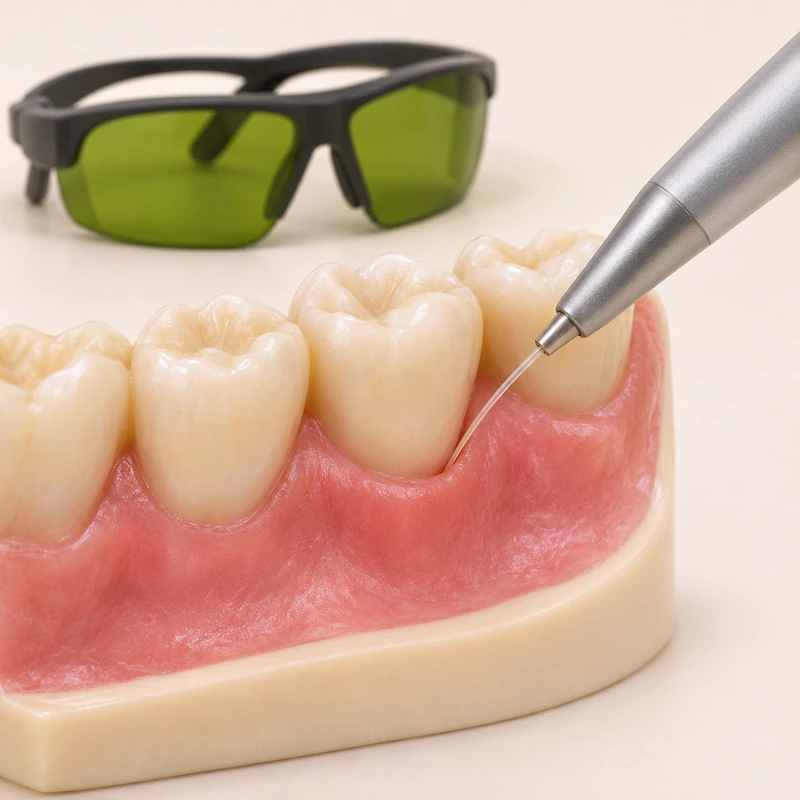
Different wavelengths and applications affect tissues and deposits differently. Evidence for one technique therefore cannot be transferred to every procedure advertised as laser therapy.
The 2020 EFP S3 guideline advises against lasers as an adjunct to non-surgical instrumentation. The studied procedures did not provide sufficient evidence for a reliable additional benefit.
Diagnosis, established basic treatment and maintenance are central. Before an adjunctive procedure, discuss its specific aim, possible disadvantages, cost and relevant evidence.
Mechanical deposit removal and ongoing maintenance.
No; clinical evidence of benefit matters.
It advises against adjunctive lasers for subgingival instrumentation.
Three steps. No audio.
Each scene can also be selected manually.

Silent educational film with German on-screen text and simplified teaching images. Not a patient case or a promised treatment outcome. The full English explanation is available as text.
A measurable effect on tissues or bacteria does not by itself establish better long-term outcomes. Relevant clinical comparative trials are needed.
Certain devices can act on deposits under particular conditions. This does not make lasers a general replacement for professional mechanical periodontal treatment. The specific procedure and its evidence matter.
No. Antimicrobial photodynamic therapy combines a light-sensitive dye with light. The EFP guideline also advises against the evaluated applications as a routine adjunct to non-surgical treatment.
No. Its recommendation concerns particular periodontal applications. Other procedures and indications need separate assessment. Equally, the word laser does not establish painless, risk-free or superior treatment.
You can bring this question to your appointment:
What added benefit is expected from this specific procedure in my case, and which comparative evidence supports it?
An individual assessment can clarify the findings and whether referral is needed.
Arrange an assessmentAppointment selection at DoctolibA measurable effect on tissues or bacteria does not by itself establish better long-term outcomes. Relevant clinical comparative trials are needed.
Editorial research: . General information, not an individual diagnosis or treatment recommendation. Teaching illustrations are simplified and do not depict a patient case.
If you turn this on, this website stores which guides you open, separately from advertising preferences. The markers expire after a fixed 30-day period from activation. The list is not sent to us by this feature. You can turn it off here and delete the markers.
Other people using the same browser profile can also see the markers. German and English versions share one marker. Expired entries are removed the next time you open a page with this feature; deleting browser data may remove them earlier. “Viewed” means opened, not read or completed.